It’s early in the morning and the sun has not risen yet. My bag is on the backseat of the cab as I sit in front. The neon blue of the car stereo pulsates with the beats of a Russian song. Apart from the odd truck, there is no traffic and our car speeds along smoothly. To my left, on the driver seat, sits Ali, one hand on the steering wheel, the other out the window, holding a cigarette. He is heavily built and has a very deep voice. His gaze is fixed on the road ahead. After a night of being stuck in the air conditioned insides of airports, the cool, natural breeze feels good.
The road from the airport to my hotel is a long and straight one, intersected at times by other long and straight ones. Out the window, my first glimpses of Nur-Sultan, bathed in the hues of dawn, are either of total nothingness or absolute awesomeness. Vast empty expanses of land with nothing but the wires of transmission towers following us along for the most part with sudden appearance of interesting looking buildings and on one occasion, space rockets! Not one but three!
“What was that?” I ask Ali, pointing out the window at the rockets.
He finished his drag and said something in Kazakh or Russian; smoke coming out of his mouth as he talked. I believe in the stream of foreign words, I heard one familiar one. “Muzeyi” meaning “Museum” in Russian.
(I Googled later on and I think it was the city’s open air space museum.)
As I sit, looking out the window, I realise that tomorrow this time I would be heading back to the airport to catch my flight to Tashkent. This leaves me with just a day to see Nur Sultan. Kazakhstan allows Indians with Ordinary Passports a transit visa free stay for 72 hours. If you are travelling with Air Astana and have signed up for their Stopover Holiday program, you are also entitled for a night’s stay at one of their partner hotels for just one dollar, and that includes pick up and drop. After about forty minutes of looking out the window, the car takes the right exit and stops in front of the Park Inn, which advertises to be a 4 star hotel; a refreshing change from the dormitories I am used to staying at. I get an early check-in and decide to go to bed till the sun comes out and the breakfast buffet starts.
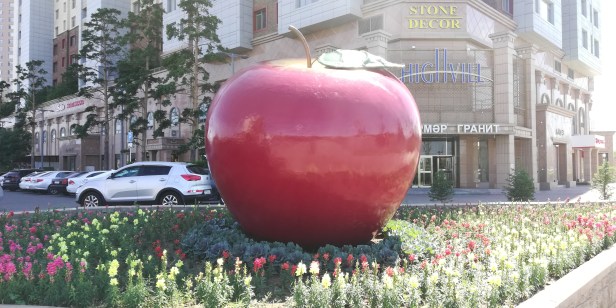
Earlier this year, the city of Astana was officially renamed Nur Sultan, after the country’s former president, Nursultan Nazarbayev, who resigned after a 30 year stint. This is not the first time the city has undergone a name change. Till 1999, it was known as Akmola which meant “white tomb” or “white plenty”.
Rays of the morning sun enter into the room from the wall length window, waking me up. It took me a moment to register where I was. I fish out my cellphone from under the pillow to look at the time. It’s 7.30 am; a little over 2 hours of sleep. I stumble out of bed and see out the window of my 10th floor room. The road outside was full of cars and buses. People thronged the bus stops and the sidewalks on their way to work. On the opposite side of the hotel were a series of tall office buildings. My body urges me to return to my soft, comfortable bed but I remind myself that I only have a day to explore this city.
Downstairs, the breakfast buffet is an elaborate affair with different kinds of juices, teas, cheeses, breads and more. A sandwich, few strips of bacon and about a hundred cups of coffees later, I am ready to head out and see the city.
It is a pleasant morning with clear blue skies and a bright sun but it is expected to get hotter as the day went on. Following the direction given by the receptionist, I get on a bus that would drop me off at the National Museum of Kazakhstan.
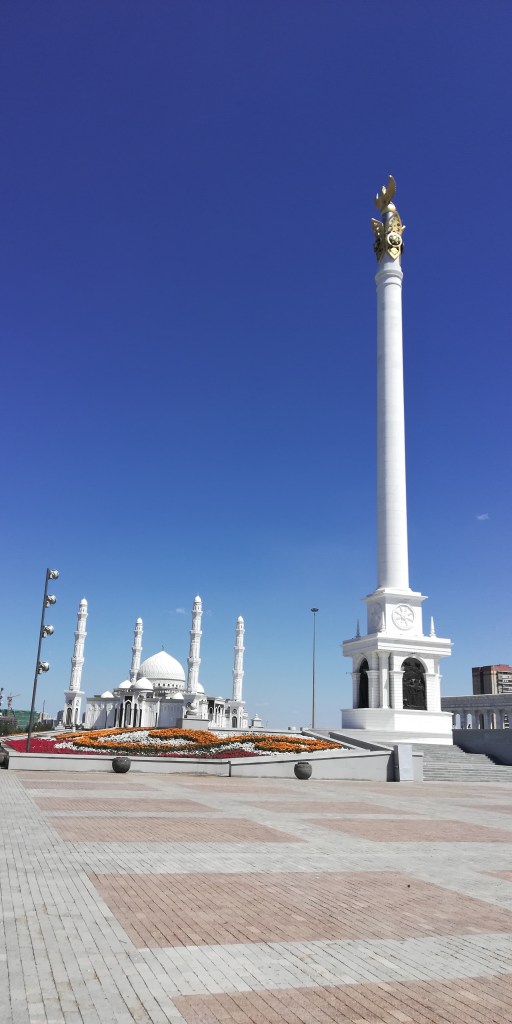
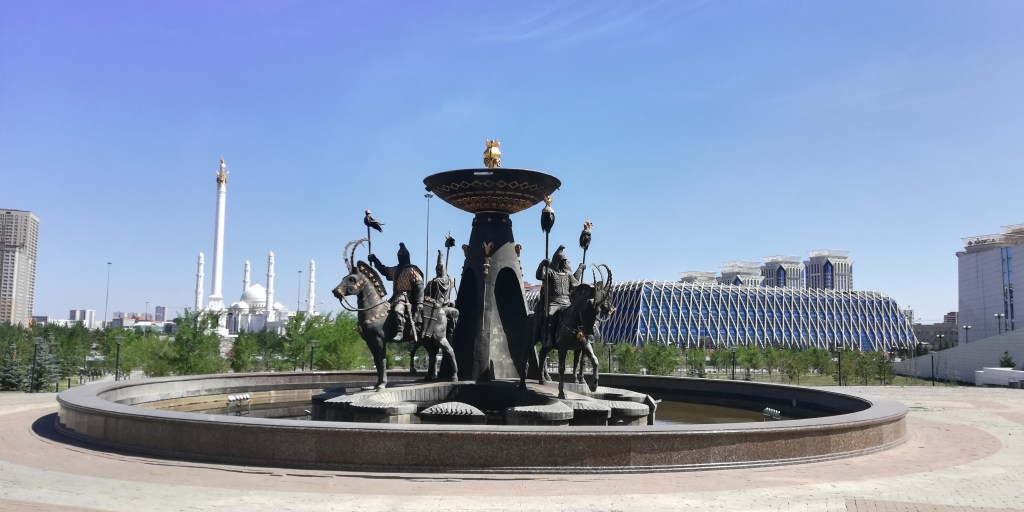
The Hazrat Sultan Mosque is a short walk away; its white minarets and dome is visible in the distance. Named in the honour of a revered sufi poet, philosopher and saint, this mosque is considered to be the biggest mosque in Central Asia. Like most things in Nur-Sultan, this mosque, inaugurated in 2012, is also relatively new. I cross the road and enter into the concrete compound. The speakers installed outside of the main gate fill the air with pious prayers. I follow the crowd of devotees, deposit my footwear at the wall lined with shelves and enter into the washing area where people cleansed their feet, hands and face before entering into the main hall.
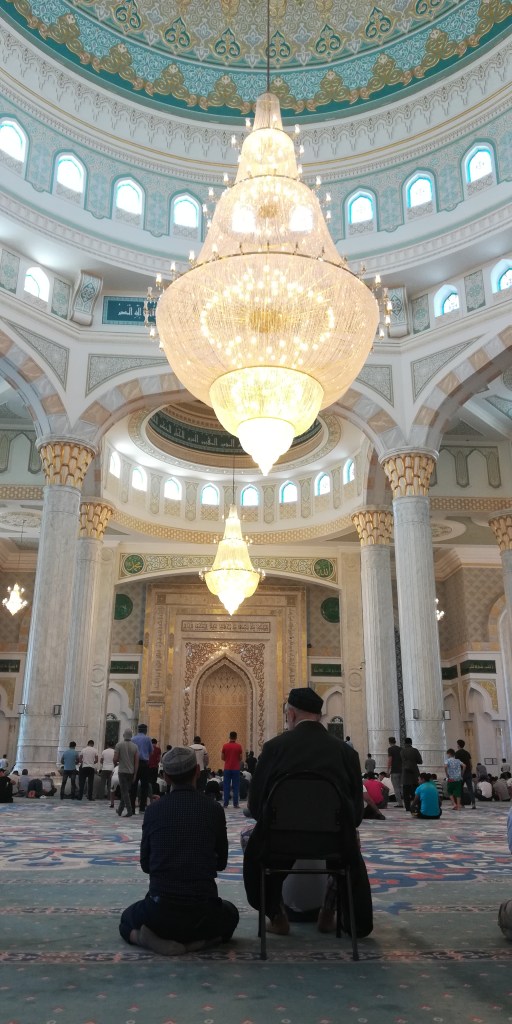
Chandeliers and traditional engravings decorate the high ceilings of the hall. Some sit on their knees, some cross legged, offering prayers while others sit on the carpeted floor along the walls, watching the proceedings. Though there must have been over a hundred people inside, there is no noise. I decide to sit at the foot of a column and take it all in.
I watch as a young man walk past holding the hand of a slender elderly man. In his other hand he carries a chair that he places a few paces in front of me and then helps the elderly man onto it. As the elder makes himself comfortable on the chair, the young man sits down on the floor beside him. They then sit in silence and soon their lips start moving quietly as they recite prayers with their eyes closed.
In 1997, the capital of Kazakhstan was moved from Almaty to Astana (now Nur-Sultan) because the former lacked the infrastructure required for a capital city. Further, it was considered to be over populated and far away from the geographical center of the country. Astana was considered a better choice. It was spacious enough to support the growth of commerce and industry and also a larger population. Walking along the road from the mosque to the Presidential Palace, you could see how spacious the city was. It seems like the site of a new township project; vast empty expanses, dotted with clusters of concrete buildings.
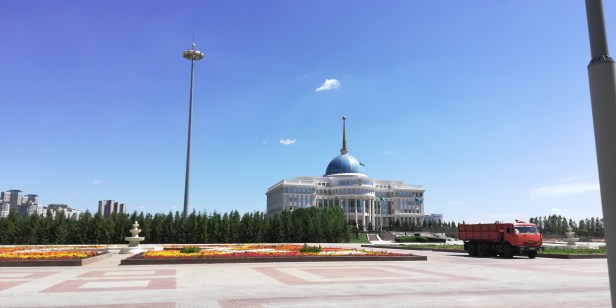
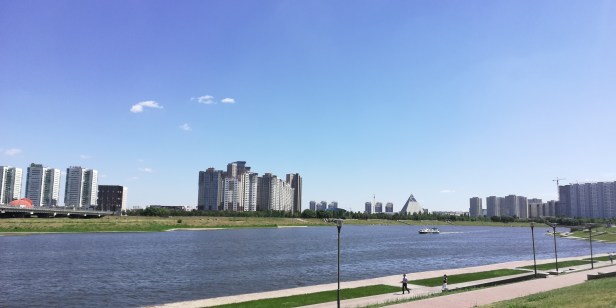
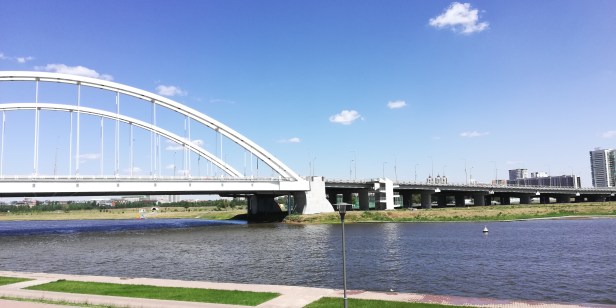
I take a long walk along Sarayshy street, passing the conical Palace of Peace and Reconciliation and a couple of parks, and reach a bridge that crossed over the Ishim river. The sun is much hotter now and there are not many people walking along the sidewalks of the bridge. As I reach the middle of the bridge, I see the Presidential Palace in the distance to my left. The roof of the palace is adorned with a blue dome and a golden needle like ornament. Lush gardens surround the palace and are being laboriously tended by a group of men. As expected, the gates of the palace are heavily guarded and I am not allowed to enter.
Opposite the palace, on the other side of the road, I see the famous Baiterek Tower. Sometimes locally referred as “Chup-a-chups” for its resemblance of a lollipop, this tower has become the most popular landmark of the city. The unique design of the tower originates from Kazakh legends and represents the mythological tree of life where the magical bird of happiness, Samruk, built its nest and laid a golden egg.
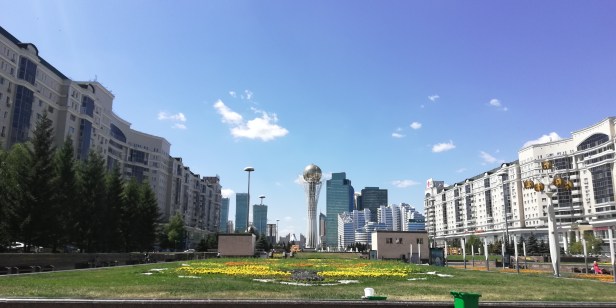
I decide to take a break and walk into a nearby cafe, with outdoor seating, overlooking the tower. The menu is written in Kazakh but thankfully, it also has pictures alongside. I point to a picture of what looks like iced tea on the menu to which the waiter nods and leaves. The iced tea turns out to be more of a virgin mojito but it was pretty good.
“Aap India se ho?” (“Are you from India?”)
A middle aged Indian lady asks in Hindi as I sit outside the cafe, waiting for the order to arrive. She and her husband sit in the corner table with a couple of coffee cups and a packet of Haldiram’s, which I assume they must have carried that all the way from India.
We chat for a bit and I find out that they are also from Mumbai. “Andheri” she tells me. They are on their way back to India and were availing the same visa free transit facility that I was. They were returning from Tashkent and Samarkand and that gave us a lot to talk about. After getting to know that I was also heading there, her husband shows me pictures of their trip on his DSLR camera. It was the most I had talked ever since I had left home and it almost felt weird. I was getting reintroduced to my own voice.
Early afternoon, I decide return to my hotel after a quick lunch at a local joint and fall asleep watching a bunch of people washing horses on a local TV channel. Horses hold an important place in the Kazakh culture and they have been their loyal companions since their nomadic beginnings. In fact, they have a section dedicated to showcasing the relationship between the early Kazakhs and their horses at the National Museum. There are displays of the early stables and saddles and detailed information on the various kinds of horses in the country and their dietary habits.
By the time I wake up, its a few minutes past 8 in the evening. I have a little over 6 hours left before I have to get back in Ali’s cab and head to the airport. The folks on TV were now feeding horses. I gingerly get out of bed and look out the window. It is still not dark, for some reason. The sun works overtime in Central Asia. The traffic is still just as crazy as I had seen in the morning. People were now returning from work.
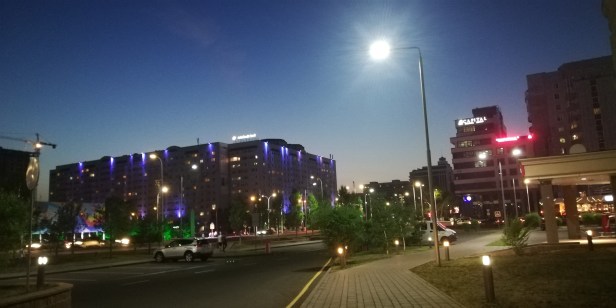
I decide to take a walk around the neighbourhood even though I have a feeling there was not much to see around. And barring a supermarket that sold delicious looking cakes, there was not much to see or do. A cafe near the hotel looked nice and I decide to grab a cup of coffee. It was highly unlikely that I would get much sleep at night and I needed a lot of caffeine in my system to keep me awake. The sun finally went down around 9 PM and the street lights and buildings lit up.
By around 1.30 AM, I had taken a shower, had a change of clothes and seen enough horses on TV. I still had about an hour to kill before Ali was supposed to pick me up. I decide to sit on a bench outside the hotel gate but am soon driven back inside by vicious mosquitoes.
“The bar is open.” The receptionist told me with a smile, on seeing me pacing around the empty lobby, killing time. I love receptionists. They always have the best ideas.
I probably woke up the poor bartender as I see him hiding a yawn while pouring me a glass of beer from the tap. Soon after, he hands me the TV remote and disappears, leaving me all alone in the desolate, dark bar. I switch channels till I find the horses. They were now racing each other.
Ali was unexpectedly on time and soon we were retracing our way back to the airport, following the wires of the transmission towers along. The lights of the car stereo were pulsating. Ali lit a cigarette and rolled down the windows, letting the breeze in. One hand on the steering wheel, fingers tapping on it with the beats of the song, his gaze straight ahead watching the road. We caught a glimpse of the blue dome of the Presidential Palace and passed the space rockets.
“Astana Good?” He asks with a smile, a few minutes into the ride.
“Yes, very good. I did not really see much. Next time I’ll stay longer and see a bit more of Kazakhstan. One day is not enough, you know.”
He looks back at me as if trying to figure out from my expressions and tone what I was saying.
“Astana good.” I say with a wide smile and putting my thumbs up.
“Good. Good.” He says, shaking his head, letting out a laugh, almost like he was relieved that I liked Astana.
And as he did that, a speeding car, out of nowhere, got dangerously close to us, its tires screeching as it drifted toward us, and then, regaining control, it quickly sped off. All of it took less than a second.
I froze in my seat. I felt my lips moving, muttering “What the fuck!”, but no voice came out. Ali was still driving, his head out of the window, shouting out at the fucker who almost killed us. He got back in, lit another cigarette and took a few drags. He looked at me and, I don’t know why, starting laughing again. Louder this time. Seeing him laugh, made me laugh as well.
And that moment, of both of us laughing for absolutely no reason, happy to be alive, in the dead of the night, in a grim looking car that almost became our coffin, speeding along the highway, racing other cars and trucks, much like the horses on TV, is the mental picture I have of my stay in Kazakhstan.
And trust me, it is a pretty cool picture.
I may not have seen a lot in Kazakhstan but I was glad that I saw something. And whatever I did see, is enough to make me dream of coming back someday and seeing a lot more.


Leave a Reply