
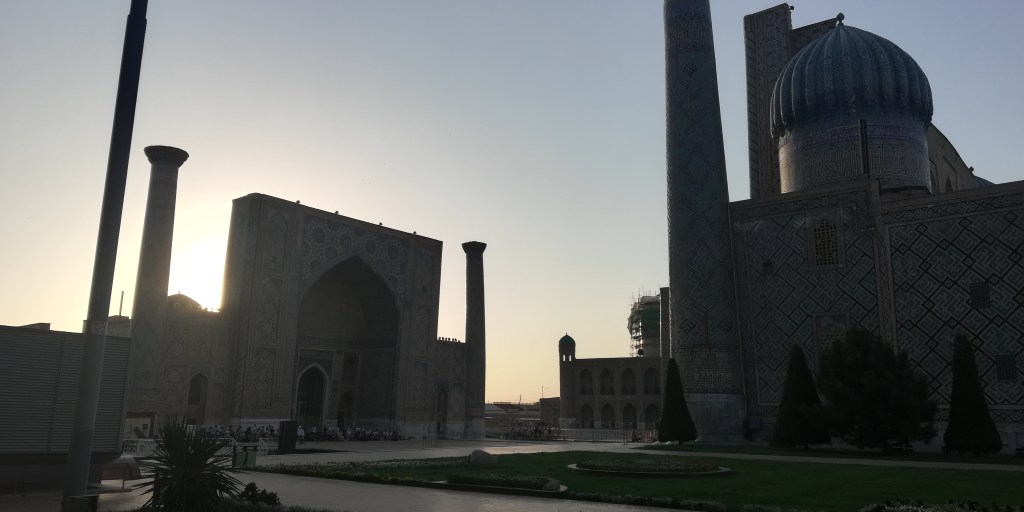
It’s 2 am and I lie on the bed awake in the humidity of my small room at Hotel Rehmon. The pedestal fan, that I had strategically placed near my head, sways left and right, providing very little respite. I can feel the bedspread sticking to my back, wet with sweat.
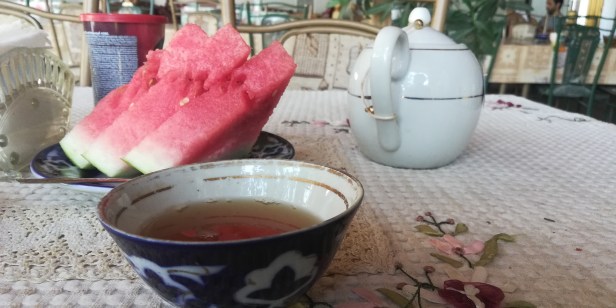
Frustrated, I get up, grab my e-book reader and t-shirt and step out of the room. My room is located on the first floor, near the common area where breakfast is served every morning. It is also where guests hang out in the evenings and hot afternoons, enjoying tea and freshly cut watermelons. There is no one here now, of course.
As I walk to the nearest table, the cage hanging on the nearby wall starts rattling and the parrots inside start screaming their lungs out; scared shit less. I quickly step away to another table, a bit further away from the cage as their screams pierce through the thick blanket of quietness of the night. A moment or two later, the parrots settle down and the quiet cover engulfs the terrace again.
“Fucking parrots.”
Though still humid, the weather is much more tolerable outside. I see silhouettes of the leaves of the climber plants move with the light breeze. I pat off the dust from the table and open Peter Frankopan’s “The Silk Roads- A New History Of The World”.
The Ancient Silk Road
It is impossible to talk about Samarkand without mentioning the ancient Silk Road, which facilitated trade between the East and the West. The silk that the noblemen of Rome wore traveled thousands of miles, exchanged many hands and was traded multiple times as it made its way from China. Similar parallels can be drawn for spices, ceramics, animals, precious stones, weaponry, etc.
Not just goods, the Silk Road also enabled the exchange of ideas, philosophies, cultures, cuisines and religion. The spread of Islam, Buddhism and Christianity can at least be partially attributed to these trade routes that ran from China to Europe and Northern Africa. As trade prospered, towns and cities cropped up along the routes. The incredible wealth and prosperity also made these cities attractive in the eyes of conquerors from Europe, Mongolia, Persia, and the Arab peninsula. The history of this region is intertwined with the travels and conquests of personalities like Alexander The Great, Genghis Khan and Uzbekistan’s own, Amir Temur.
The humid night is followed by a hot day. I walk through the winding alleys towards the city’s main square. It is nine in the morning and it is already over 30 degrees Celsius. I walk along the shades of the concrete houses that stand on either side of the alleys. It is strange to see cars parked inside some of the houses considering most of the alleys look too narrow for any vehicular movement.
The Samarkand Bread
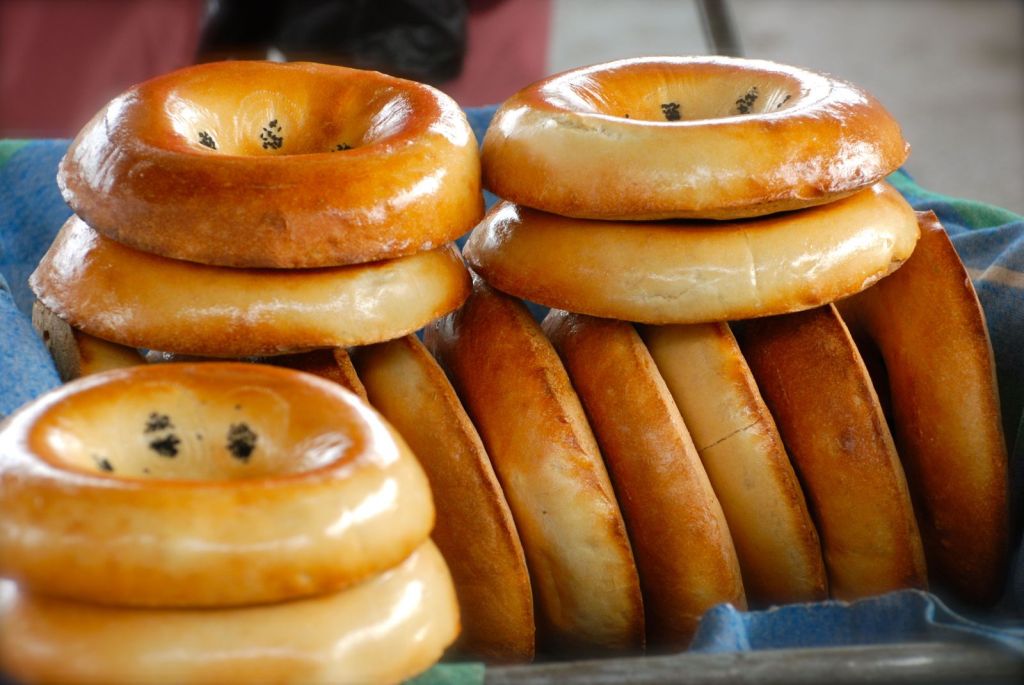
In these alleys, it is not uncommon to see people carrying bread early in the morning. Bread is an important part of the cuisine of this region and is served along with every meal. Samarkand is famous for its bread. They are glazed, thick, round and sprinkled with sesame seeds. The bread of Samarkand is considered so good that people visiting the city take these back as gifts for their friends and family.
Legend has it that once the king of Bukhara craved for the Samarkand bread. He asked his staff to find the best baker in Samarkand and bring him to Bukhara.
“From now on, you will bake your bread here.” The King told the summoned baker from Samarkand.
But, the bread did not taste the same. It was not as soft as the ones in Samarkand. The baker told the king that the ingredients were different in Bukhara. The king sent his staff back to Samarkand to get the local flour, water, and the baker’s own oven.
Still, something was amiss. The bread was still not the same.
This continued for a while. Different ingredients were sourced from Samarkand but the bread just would not taste the same.
One day, the king summoned the baker to his court and told him to leave.
“You can go back to Samarkand now. I can bring flour, water, and your tandoors from Samarkand but how do I bring the air of Samarkand. It is there that the secret of the bread lies.”
The Registan Square
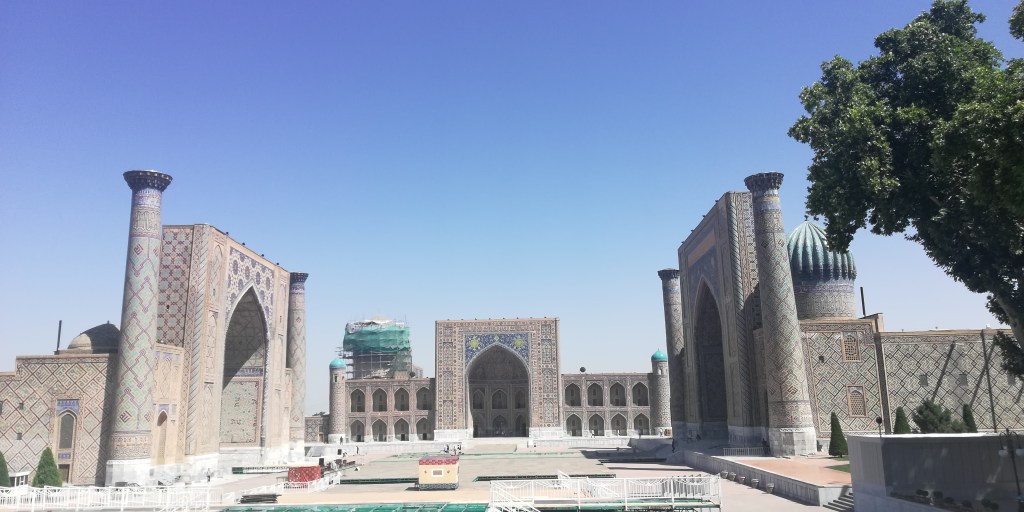
It is like I stepped out of the maze of the alleyways and stumbled inside a postcard. We may have seen pictures of the Registan Square but being there, standing amidst those ancient buildings is a different story altogether. Back in the day, this used to be the centre of town and all its roads led here. All important orders from the Khan were announced here. It used to play host to vibrant markets, busy with trader and merchants from all over Central Asia, Africa, and Europe. Armies were collected here before they left for war. It is said that the square also stood witness to public executions. Instead of the concrete tiles, on which I stand today, the square used to be covered in sand.
The three mammoth structures that stand around me were madrasas- which were centers of learning, much like schools and colleges of today’s times. At the far end stands the Ulughbek Madrassa, named after the grandson of Amir Temur, and is the oldest of the three. The one in front of it is the Sher Dor Madrassa, which was constructed in the early 17th Century by Yalangtush Bahadur as a mirror reflection of the old madrassa. The word “Sher” means tiger and is in reference to the images of two golden tigers on the gates of the madrassa. The third one is the most recent of the three and is named Tilla Kori Madrassa and is the most vividly decorated.
I visit the three madrassas, two of which led into an inner courtyard. This is where the students would gather and study astronomy, religion, and science. Though at present, it is home to souvenir shops selling all kinds of tourist junk, while wandering around the courtyards, it is easy to find yourself transported to a different time.
The shades of the madrassas walls offer refuge from the sun. It is a great place to sit and people watch. Being the most popular landmark of the city, the place is always buzzing with tourists. I watch the tour guides lead their groups through the square, explaining its rich history. People take pictures using their expensive cameras and selfie sticks. Guards in uniforms patrol the area, keeping the visitors in check.
The square also plays host to an annual music festival. I see the workers toiling in the heat as they set up the stage and fix the lighting. In the evenings, when the square is barricaded to keep the tourists out, you can see the performers rehearsing for the festival. During my stay in Samarkand, I would stand outside these barricades at sunset and see the sky slowly turn golden and let the soothing tunes of their songs lead us into the night.
The Living King
That afternoon, after a short, sweaty nap at my hotel, followed by three cups of tea on the terrace, listening to the hoarse parrots, I step out to the maze of the alley again. This time towards a different direction. I see a car squeeze its way through the narrow alleys, passer-bys almost pasting themselves on the walls to let it pass.
“Shah-i-Zinda?” I ask a group of kids playing football in one of the alleys. It takes a few minutes for them to get over the shy giggles. Eventually one of them points to an alley to the left.
“Where are you from?” He asks, as I turn to leave.
“Mumbai.”
I had seen how Americans just say New York or Los Angeles and people instantly recognize the country they are from. So these days, whenever someone asks, I deliberately say the name of the city just to see if they know where it is at. I usually get an “Oh.. India” or “Hindustan” as responses, but this time the response was a bit different.
“Aamir Khan!” The kid exclaimed.
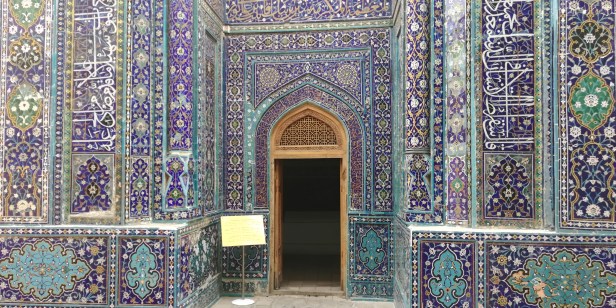
Shah-i-Zinda is a necropolis where a lot of the family members and close aids of Amir Temur are buried in lavishly spacious chamber halls. As you wander through the street that connects these chambers, you will find yourself surrounded with elaborate traditional designed facades. It is probably the most picturesque place in Samarkand.
The name, Shah-i-Zinda, or as some people say, Shahki Zinda, is a Persian word that translates to “The living king”, and it stems from a legend that is over a thousand year old. According to mythology, this grand necropolis had a very humble beginning. Though there are various versions of this story, it is said that the uncle of Prophet Mohammad, Kussama Ibn Abbas was mortally injured in a battle; his head severed from the rest of his body. As life was leaving him, he was rescued by the spirit of a saint, Hazrat Hyzr, who placed him in a well here that was filled with the water of life, which he drank and became immortal. Believers think that he is still alive and for many, a visit to Shah-i-Zinda is as holy as going on Hajj.
I find an opening in this corridor of chambers that leads me to a viewpoint from where I see the city of Samarkand lay before me. The cars on the road outside, the buildings and trees nearby, and the Registan Square in the distance, shining in the rays of the afternoon sun.
Whether you believe in the incredible legend of Shah-i-Zinda or not, the fact that structures as ancient as these still stand, while the world around it changed so much, is in itself pretty incredible.
Bibi’s Kiss
Amir Temur is Uzbekistan’s most famous son. Coming from a small tribe, he ended up ruling an empire that stretched from the Volga River to the West of India. While in Uzbekistan he is revered as a great leader, we Indians remember him as a barbaric plunderer.
It is said that when he was a boy, his right leg was wounded by an arrow which made him lame, leading to names like “Temur The Lame” and “Tamerlane”.
One of his wives, rumoured to be his favourite and a direct descendant of Genghis Khan, was Saray Mulk Khanum. Apart from being his wife, she was also his closest advisor. When he was away, she would act as his proxy and take decisions for the empire on his behalf.
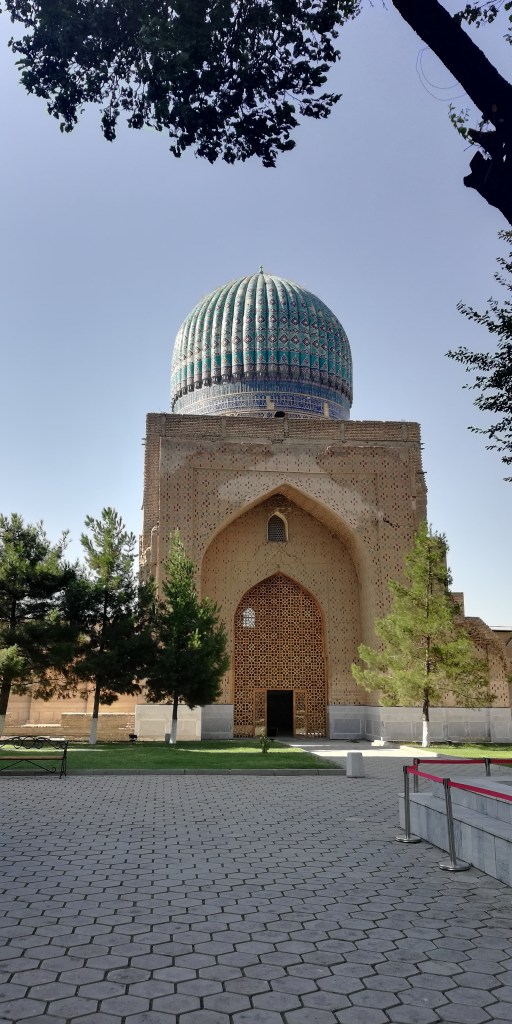
It is said that she commissioned the building of a mosque to celebrate the return of her husband from a trip to India. It was supposed to be the grandest mosque in all of the empire.
Legend has it that the construction was being deliberately delayed by the architect as he was madly in love with the empress. One day when the empress expressed her concern that the mosque will not be ready in time, the architect expressed his true feelings about her and promised that he will ensure that the construction is completed on time if she gave her a kiss.
She asked one of her servants to bring her a few eggs painted in different colours.
“Look at these eggs.” She said to the architect. “From the outside, they all look different. But from the inside, they are all the same. Same with women. You can choose any of the women from my slaves.”
The architect, in response, brought out two glasses. One filled with water and the other filled with white wine.
“Look at these glasses. They look the same but if I drink the first one, I will not feel anything. The other one will burn me. Same with love.”
Long story short, she kissed the architect, who in turn built the mosque on time, which in turn made Amir very happy when he returned and saw it. But the kiss was so hot that it left a mark on the cheek of the empress. It is unclear how the emperor reacted when he found out about the kiss. The most popular version has it that he got him killed.
I sit on the sidewalk outside the mosque, reading about its history. I don’t know how to feel about the legend. It is scandalous for sure but a bit rough around the edges.
“Wine doesn’t burn.” I tell myself. “What wine was the architect drinking?”
A large group of tourists had descended upon the landmark, taking pictures from all angles. Though it is an impressive structure, there is not much to do or see when inside. The gate of the main hall was locked and apart from the small park and a few souvenir shops, there is not much going on.
It has been a long day and I decide to treat myself to some pear flavoured soda. Though I do not exactly like it, people love it here and it is starting to grow on me. Most importantly, it is available easily and is always served chilled. And when you are sweaty and hot, that is all you really need.
The Curse
It seems no matter where I place the pedestal fan at night, my hotel room turns into a sauna within minutes. I would lay awake till late at night and wake up in the morning, soaking wet in a pool of my own sweat. On one of these sleepless, hot nights, while searching the depths of the internet for things to see and do in Samarkand, I find out that Amir Temur’s mausoleum is located nearby.
Next morning, after a quick breakfast consisting of bread, jam, and tea, I walk back into the maze of alleys and head to the final resting place of the emperor. The way to the mausoleum from my hotel is along a road, busy with cars, people and shops. It is early in the morning but the sun is already beating down. I count down each block as I cross them. I have to take a left from the fourth one.
I see a busy food joint, with pictures of beer-filled mugs; the bubbles foaming over; drops condensing on its outside. A middle-aged man stood near the entrance of the restaurant, making samsas; the heat emanating from the oven makes them look even more enticing. I promise myself that after I am done visiting the emperor, I would hang out here for a bit.
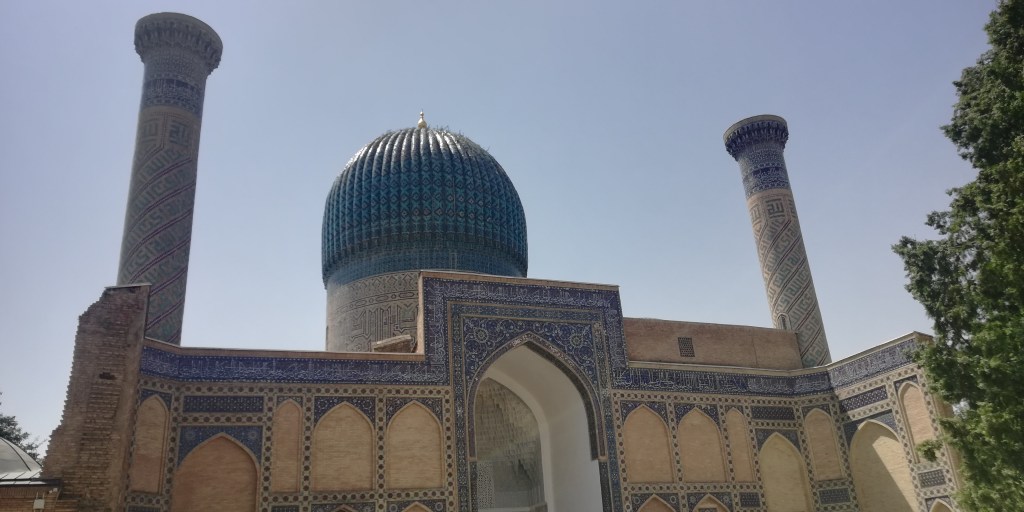
The mausoleum is locally called Gur-e-Amir and is an important place of pilgrimage for the locals. Adorning a dome and surrounded by minarets, it follows the traditional Islamic architectural design. The small courtyard outside the main hall has a beautifully tended garden.
As pretty as the structure is, it seemed a bit austere considering the stature of the man. This is especially surprising considering he prided his empire on its ability to create beautiful buildings. The inscriptions on the entry gate of his palace, Ak-Saray, in Shakhrisabz, located around 80 kilometers from Samarkand, reads “If you have doubts about our might, look at our buildings.”
It is said that the emperor intended to be buried in the city of his birth, Shakhrisabz. He was brought here when he died suddenly in Kazakhstan en-route to China. The roads to Shakhrisabz were blocked by snow at the time and it was decided to bury him here, in Samarkand, the capital of his empire.
The ceiling of the main hall is beautifully carved with the most intricate designs. In the dimly lit hall, I see the tombs of the emperor, his sons, successors, and his advisors. The stone used for his tomb is of made of green jade; setting it apart from the others.
Legend has it that Nadir Shah took away this stone to Persia but soon started experiencing bad luck. His religious advisers told him that the stone was cursed and it was subsequently returned back to Samarkand. A similar run of bad luck was faced by the Soviets during WW-II when they opened the crypts and took the remains for examination. Two days later, the Nazis attacked the Soviet Union. A month before the the battle of Stalingrad, which the Soviets won, Stalin ordered for the remains to be returned and buried with full honors.
“Whoever disturbs my tomb will unleash an invader more terrible than I.” an inscription inside his tomb says.
After a long walk through the nearby university and office complexes, I walk back to the restaurant for lunch. In Uzbekistan, in order to get some respite from the heat, there are sprinklers installed along the top of the walls of many restaurants. They continuously sprinkle thin jets of water into the air, keeping the insides of the establishment cool. I order a samsa, a bowl of Lagman- my favourite Uzbek dish- and a mug of beer. The TV screen on one of the walls played some Uzbek music video. I remind myself that tomorrow this time, I will be in Bukhara. It is supposed to be even hotter there. My time in Samarkand was coming to an end.
Fond Memories
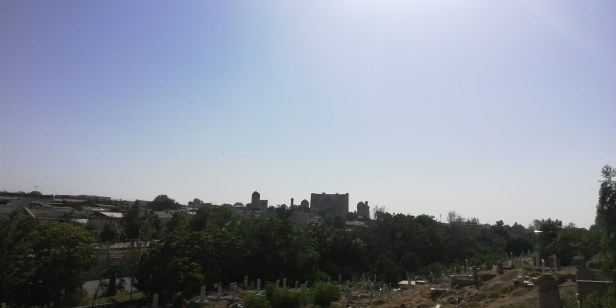
When I was young, somehow I was aware of Samarkand but a part of me did not think it actually existed (Same with Timbuktu). I counted it along with fictional places like Shangri-La, Hogwarts, and Narnia. The name itself had a certain mystique surrounding it.
Since then, I have read a bit about the ancient Silk Road and have even had the chance to visit some of the places that it passed through. But Samarkand felt different from the others. During my stay, there were times when, as I walked through some of the ancient landmarks, I would feel as if the words that I had read in the books and articles had come alive.
This is a place that is rich with history and incredible legends. Every corner of the city has a story to tell. Through the centuries of its existence, Samarkand has found a place in the tales of the greatest travellers and storytellers; from Ibn Battuta to Anthony Bourdain.
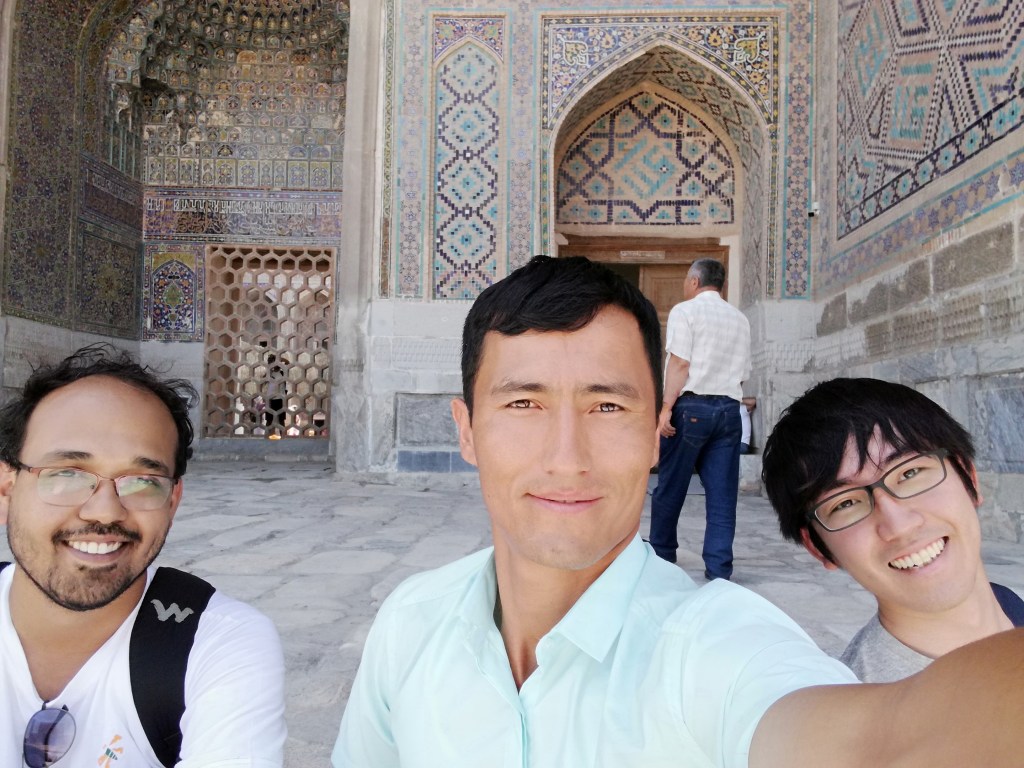
And though terribly insignificant and inconsequential in comparison, probably bordering on criminal, I feel the urge and the audacity to proudly say that Samarkand has found a place in the stories from my travels as well.
Come to think of it, I feel these are the kind of statements that would get one publicly executed at the Registan Square.


Leave a Reply