
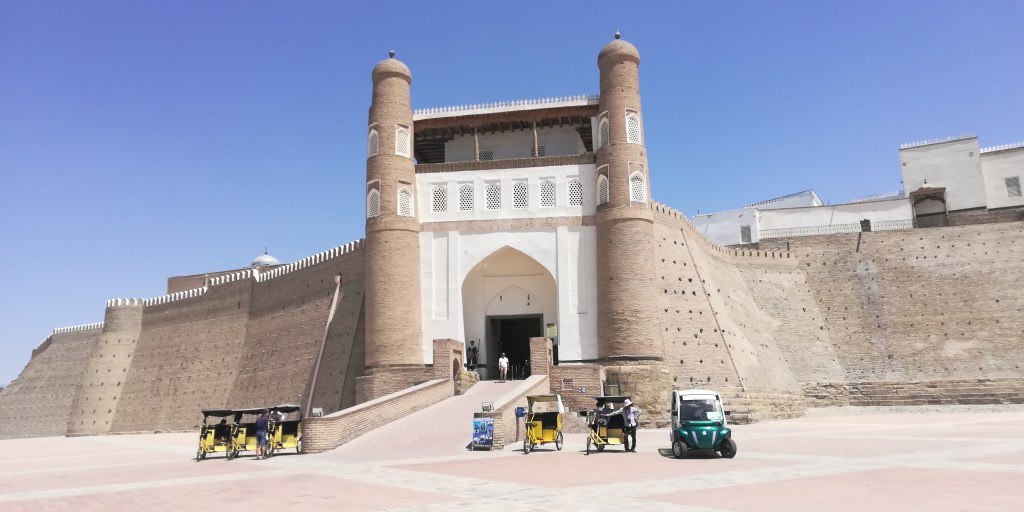
For most of the nineteenth century, the Russians and the British were in a deadlock to establish dominance over Central Asia. As the British looked to control trade routes from India to Bukhara, the Russians too were trying to expand their empire in the region by way of alliances with the local leaders and invasions. This rivalry has been coined as The Great Game.
An important moment in this game came on December 17, 1838, when the British East India Company sent one of its officers, Colonel Charles Shoddart, to Bukhara to meet the Emir of Bukhara, Nasrullah Khan, and form an alliance.
Unfortunately however, he did not make a very good first impression. He rode up to the Ark and saluted the Emir while seated on his horse, as was customary in the British Military. The local customs however, dictated dismounting from the horse, leaving it with a servant, walking to the Ark fortress and saluting to the Emir. This faux pas was followed by not bringing any tributes and bringing a letter from the Governor General of India and not from the Queen herself, whom the Emir saw as her equal. The Emir saw this as insult and as punishment, Shoddart was captured and imprisoned in a pit full of bugs.
The British did not come to the rescue of Shoddart as they had much bigger problems to deal with. They were being massacred in Afghanistan and were busy fighting the Chinese Qing Dynasty in the First Opium War.
When they finally sent Captain Arthur Conolly to beg forgiveness and bring Shoddart home, they repeated the same mistake . He too did not bring a letter from the Queen which the Emir saw as the ultimate disrespect. He too was imprisoned along with Shoddart.
Failing to hear from the Queen, on June 17, 1842, Shoddart and Conolly were brought to the square in front of the fortress. With the crowd watching, the two officers were made to dig two graves. Then their hands were tied and were forced to kneel before the Emir. And then, on his signal, the executioner sliced off their heads.
They were buried in the graves that they had themselves dug.
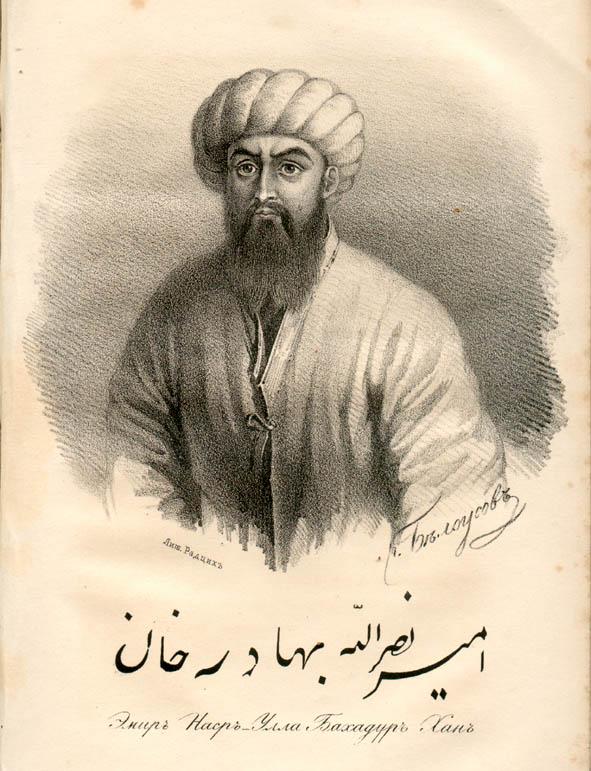
Courtesy- Wikipedia.org
I stand in the square where the executions must have taken place. It is a hot, bright afternoon. Apart from a few parked carts and the odd visitor, there is not much going on. White cotton clouds float in the otherwise blue sky above. I stand there trying to imagine the scene that day. I see the mammoth gates and the walls of the Khan’s fortress, the Ark, in front of me. Looking at its grandeur, you could tell that this was the crown jewel of the city.
There is a busy road behind me, on the other side of which is the beautiful Bolo Huaz Mosque. It is time for the afternoon prayers and it is teeming with people.
I fish out my bottle of watermelon soda that I had bought on the way over here. It was a small street stall manned by a little girl. When I had picked up the bottle from display, she gestured for me to put it back down. She then ran into her house behind the stall to get me a cold one. She knew I would need it to survive this ruthless afternoon heat.
She was right. The cold soda felt good.
Inside the fortress, were exhibits of the attires, currencies, ceramics and horse saddles from the Khan’s era. It is said that as the news of the executions spread, the Britsh public agitated and demanded vengeance. But, to the empire, they were collateral damage. It’s the price you have to pay to play The Great Game.
The history of Central Asia may have been different if the British had sent troops to defeat the Khan and taken control of Bukhara. But they did not put up much resistance and gradually the Russians took over the region, which ultimately led to the formation of the Soviet Union.
As an Indian, who has grown up reading about the atrocities committed by the British on my countrymen during their two century long occupation, I wondered why I felt bad for these British officers.
After all, greed makes you do horrible things. And a large part of Imperialism was, and politics in general is, that.
Greed.
Greed for more territory. Greed for more wealth. Greed for more power.
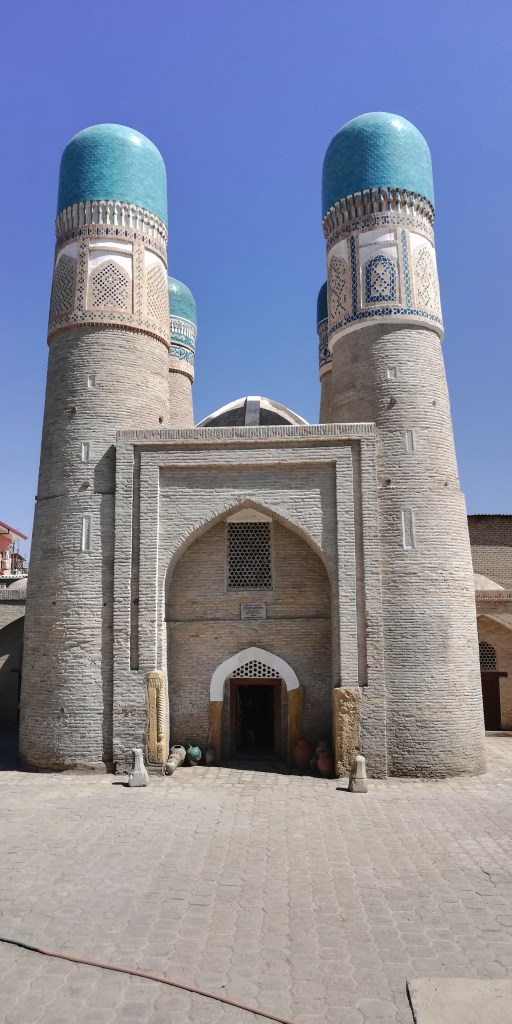
Like Samarkand, Bukhara was a major city on the ancient Silk Road. Back in the day, it was a hot spot for traders and merchants from around the world. As trade grew, so did the wealth, leading to the construction of many of the buildings that still stand today. It is considered to be the holiest city in Central Asia and it is easy to find yourself lost among the centuries old mosques and madrassas. Like most cities on the Silk Road, Bukhara was also home to bustling markets, some of which still operate. Although, looking at the t-shirts and fridge magnets, I am pretty certain that the goods on offer have undergone a world of change.
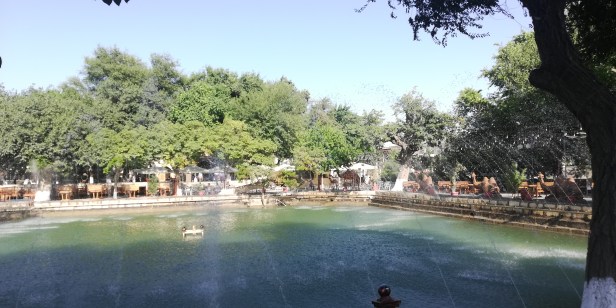
At the centre of the old town is Labi Havz. It is an ensemble consisting of an ancient madrassa, caravanserai, a small park, a bustling market with some great restaurants and a pond in the centre of it all. No matter the time of the day or the temperature, this place is always busy and is popular among tourists and locals alike. During the day, you can find people sitting on the sides of the pond or under the shades of the trees in the park nearby. Aromas of delicious bread and meat dishes emanate from the restaurants, trying to lure in tourists as they bargain for souvenirs from the shops around. The place is especially relaxing in the evenings when it gets much cooler. Traditional music ring in the air, as hot dishes make their way from the restaurant kitchens to the tables on the banks of the pond.
Beer flows and sheeshas bubble their way late into the night.
I am staying in a quaint house, a short walk from Lazi Havz. The residents of the house, an elderly couple and their son, have turned their extra couple of rooms into a hostel. Though small, the hostel has all that is required; clean toilets, comfortable beds, air conditioning and a friendly atmosphere. The couple do not speak much English but we communicate using hand gestures and Google Translate. I soon find myself calling them uncle and aunty.
I wake up every morning with the smell of sausages and eggs. If you sleep in, aunty would come and wake you up. She hates seeing the breakfast she so laboriously cooked, getting cold. And, no matter how much you insist, she will not let you do your dishes.
In the mornings, uncle would fetch fresh bread from the local baker and in the evenings, he would make sure that all the guests are back before he locked the main gate for the night. He was always trying to help in any way he can and always had a smile on his face. And when he smiled, you could see his couple of golden teeth shine. Teeth encased in gold is considered to be a symbol of wealth and prosperity among the people here.
During my four nights stay at the hostel, I shared the dorm with an Irish middle aged, well-travelled man, named Andrew. He had arrived in Bukhara after a visit to Turkmenistan and was planning to visit Samarkand and Tajikistan in the next few weeks.
“Oh, I love India. I gained 5 kilos in 3 weeks there.” He said, when I told him where I was from on my first day.
Every evening we would sit till late, exchanging stories about the places we visited that day and our lives back home. On one of these evenings, he shared that he recently quick his job as a teacher in Paris to travel around the world. He wished to write a book about his travels someday.
“Who the hell leaves Paris?” I wondered.
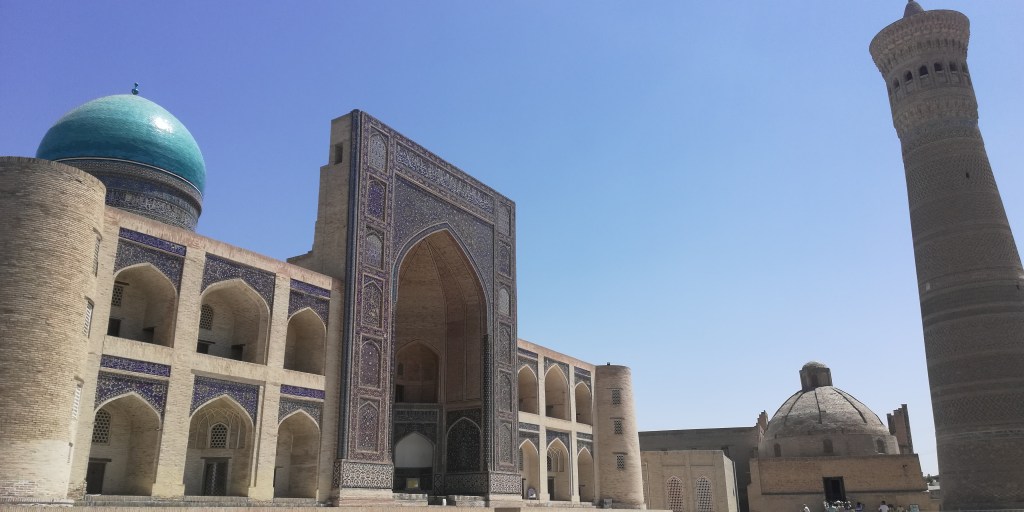
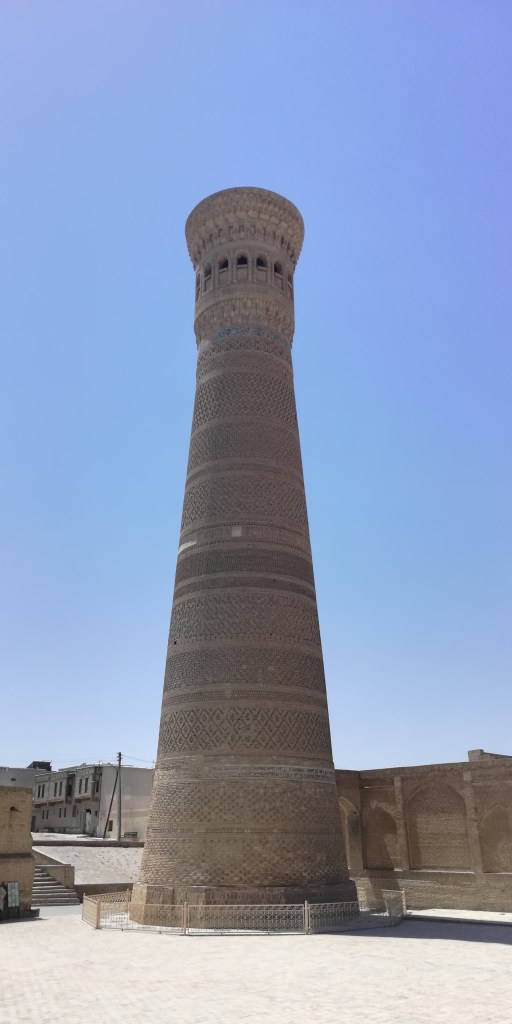
Bukhara is one of the oldest cities in the world and one of the sites that stood the test of time is the Kalyan Minaret. This used to be a lighthouse to help guide the Silk Road caravans entering and exiting the city. As time passed, it became an iconic landmark of the city.
Legend has it that when Genghis Khan invaded the city, his forces burning down and looting everything in its path, he came upon this minaret. When he gazed up at this tall structure, his hat fell down. As he bent down to pick it up, he realised that he was kneeling before the minaret. He ordered his forces not to harm it in any way.
“Such is the greatness of this structure that it forced me to take off my hat.”
I stand, looking up at the minaret, probably around the same spot where Genghis Khan once stood. Thankfully, I am not wearing a hat. I see tourists around me, posing in front of it, taking pictures. Some sit in the shade along the sides of the boundary walls, trying to find some respite from the heat. A few feet away, a guide briefs his group enthusiastically in French. His animated hand gestures attract the attention of those passing by.
An Asian man, probably Japanese, lies on the sizzling hot ground, trying to capture the magnificence of this monument in his camera. Every few seconds he gets up, pats off the dust from his clothes, looks at the photo he has just taken, and then back on the ground he goes. This went on for a bit until he finally gave up and walked away patting off his clothes one last time.
Sometimes a landmark attracts people as interesting as itself.
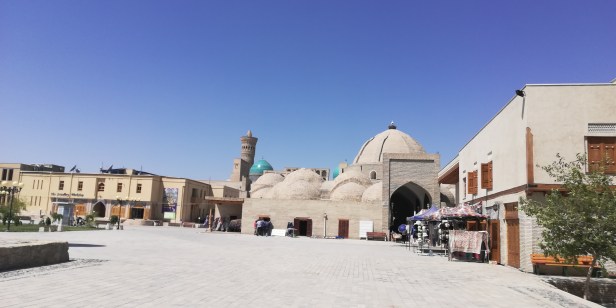
I spent my days in Bukhara exploring the narrow alleyways of the old city, discovering ancient mosques and madrassas. It is incredible how these buildings are still intact. Hole in the wall cafes and restaurants have sprouted out around these old landmarks; providing its patrons a place to rest. Bukhara has always been a city for travelers and it caters to the needs of a wary traveler today as it did back in the days of the Silk Road. Walking down its winding alleys, you will be greeted with curious looks and smiles.
Exploring the old center, you quickly become aware of the city’s signature flat roofed buildings with sun dried, light brown walls. Reflecting the city’s past, they stand in stark contrast with the city’s modern present. You see these grand structures stand in front of shops with flashy signs and roads busy with cars.
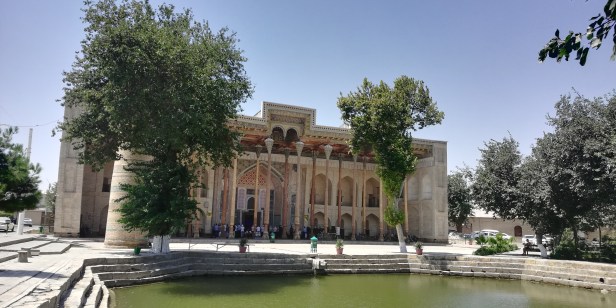
On my last evening in Bukhara, I visit an outdoor bar near the Lavi Habz for some cold beer. After a day out in the sun, I feel like I have earned a cold mug of the local brew. Uncle had hooked me up with a driver that morning who was willing to drive me to Khiva at a very reasonable price the next day. I need wake up early and be ready to make the five hour trip tomorrow.
Up above, clouds have been moving in all evening and as I sit near the pond, surrounded by people unwinding after a long day, it starts drizzling. The rain gets heavier within minutes and I see the servers running around, putting giant pedestal umbrellas above each of the tables. The sweet smell of rain drops hitting the hot soil fills the air. I see kids come running from the distance, their faces wide with smiles, and dive into the pond.
The rain stops after about half an hour, leaving us with its fond memories and puddles around the sidewalks. The sky slowly turns dark, leading us into the night.
“I thought I will find you here.” Andrew shows up and takes the chair next to me. I am not surprised by his presence. After all, Lavi Habz is the place to be in the evenings. The music from the nearby restaurants, combined with the aromas of food, the lights from the shops, the cool breeze and the chatter of the people around, made the environment feel festive.
As the night progressed, one beer led to more and soon we lost count.
“Do you ever regret quitting your job to travel?” I ask him, a few beers in, still finding it hard to believe that someone would willingly leave Paris.
He puts down his mug on the table and leans forward to look straight at me.
“Never regret doing something that makes you happy… Never.”
How do I sum up my time in Bukhara?
How do I describe the sense of being at home so far away from home?
How do I explain the joy of walking down alleys steeped in history?
How do I express the feeling of being humbled by the kindness of total strangers?
How do I tell the story of a place about which so much has already been written and told?
Like most great cities around the world, Bukhara too has been through some very tough times. Throughout its long history, the city has been invaded, ruined and destroyed by the greed of powerful empires. The story of Bukhara is much more than the story of trade and commerce of the Silk Road; much more than the legends surrounding its incredible monuments; much more than the tales of the Emirs that ruled the land.
It is also a story of human grit and determination. To see your beautiful home left in ruins, covered in blood and ashes, time and time again, and to pick yourself up and find the courage to build it back again, brick by brick, in the hope of seeing a better tomorrow is a testament to the spirit of the people of Bukhara.
But somehow that story has not been told yet.
Though the story of the Emir putting up a spectacle of cruelty in front of his fortress is well documented, the stories of the people standing in the crowd that day, witnessing his wrath, is not. The builders, the artisans, the traders, the farmers get, at best, a mere passing mention in our guidebooks.
All we are left with are the remains of what they used to wear, the tools they used to work with and the currencies that they used to use, locked in the glass cages of our museums.
And somewhere in these remains their extraordinary stories still lie hidden.


Leave a comment