
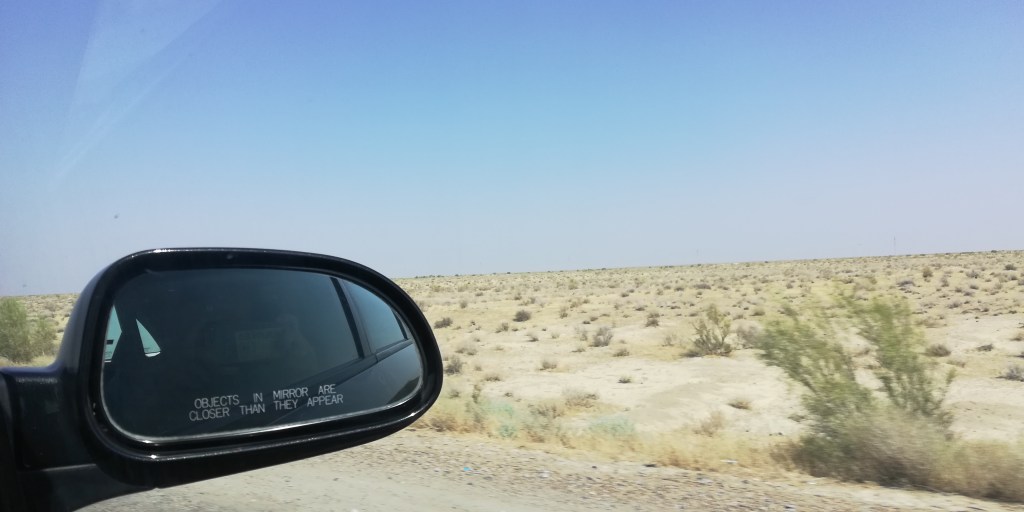
I sit in the passenger seat of the car, looking out the window. The view is not much; mostly empty, dusty landscapes with unkempt shrubs, but it is not like I have much to do any way. The breeze coming in from the window, makes the mid day heat bearable. It is amazing that a country that was home to beautiful cities like Samarkand and Bukhara, can also be home to such dull, barren lands.
The driver, a man named Ruslan, does not speak any English. He is busy driving the car, while munching on an endless supply of sunflower seeds that he had packed for this trip. I put on my headphones and gaze out the window, counting the cars we pass, hoping to bore myself to sleep in the process.
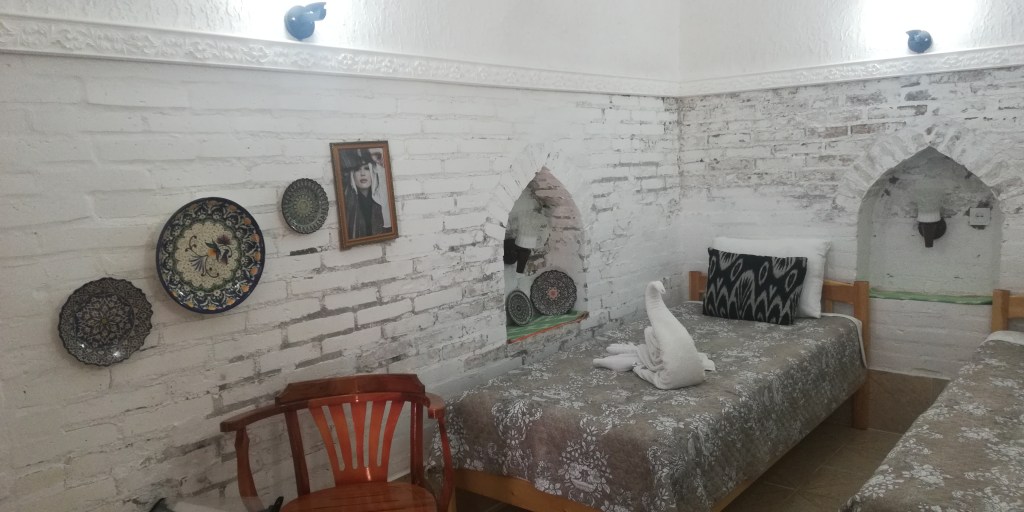
Khiva is a town near the Turkmenistan border, located about 450 kilometers from Bukhara. Its popularity stems from its historical significance and the excellent state of preservation of its Inner City, Ichan Kalan. That aside however, the town does not have too much to offer. As a result, most visitors to the town spend one or two nights there before moving on. I, however, have splurged on a four nights stay at a nice hotel, near the gates of the inner city. I would have a private room, attached bath, TV and air conditioning. What more does a man need?
After a couple of weeks of being constantly on the move, the idea of a few slow days is incredibly enticing.
Khiva is an ancient town, drawing its roots from the legend that Noah’s son, Shem, discovered a well here, which people said, had “Kheyvak”, meaning “sweet water”. Though located on a side route of the great Silk Road, the town was the hub of a thriving slave market. Slaves from all over Central Asia and Africa were brought in here to be sold off like cattle to the highest bidder.
We stop thrice on the way over to Khiva. Twice to refuel the car and once at a market from where Ruslan bought a couple of melons. He is a resident of Khiva and was going to see his family after two weeks. He was a friend of my hosts in Bukhara who had put me in touch with him, that ultimately led to this trip.
As we drove into Khiva, the fortified walls of the old city became visible in the distance. A small cabin like structure, made of mud and bricks, stood on top of the front part of wall. This was the watchtower which protected the inner city and guided the caravans.
Back in the day, Khiva was divided into two parts. The inner city, Ichan Kala, where the Khan and his family, nobleman and high ranking officials of his court, and rich merchants lived. Most mosques and madrassas are located on this side of the wall. Outside the walls was the outer city, Dishan Kala, which was home to the general populace.
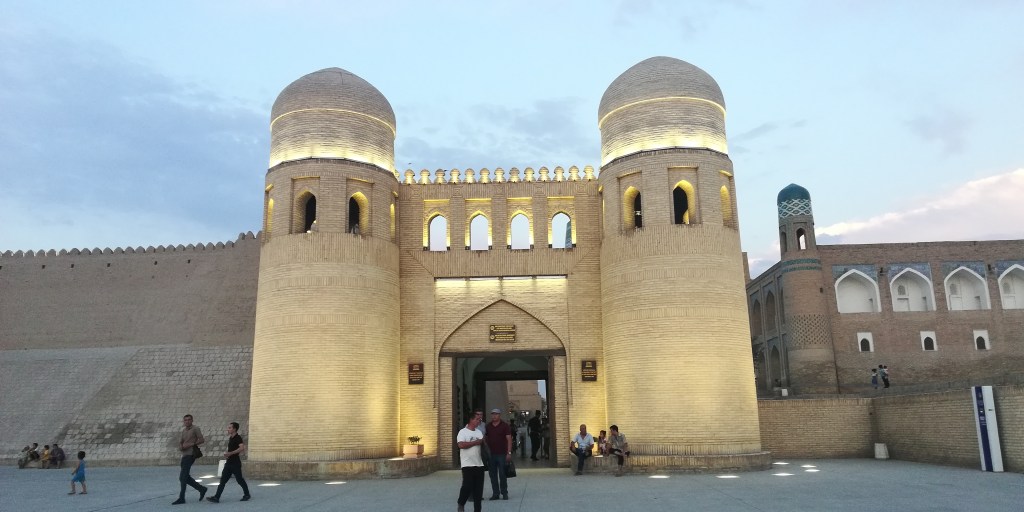
Like most cities in the region, Khiva too has had its share of invaders; from Genghis Khan and Nadir Khan to the Russians. However, by the looks of it, the town was now under the invasion of a different kind. Tourists. En-route to the hotel, I see the entrance of Ichan Kalan lined with tour buses and cars. Large groups of tourists can be seen crowding the main gates of the inner city, equipped with DSLRs and selfie sticks; a scene not very different from what one can expect outside a Disneyland.
That evening, after checking into my hotel and browsing through the available TV channels in my room, I walk to the gates of Ichan Kala. The sun was setting and the sky had turned orange. I was told by the friendly receptionist at the hotel that, in the evenings, the guards open the gates and visitors can pass freely without the need of an entrance ticket.
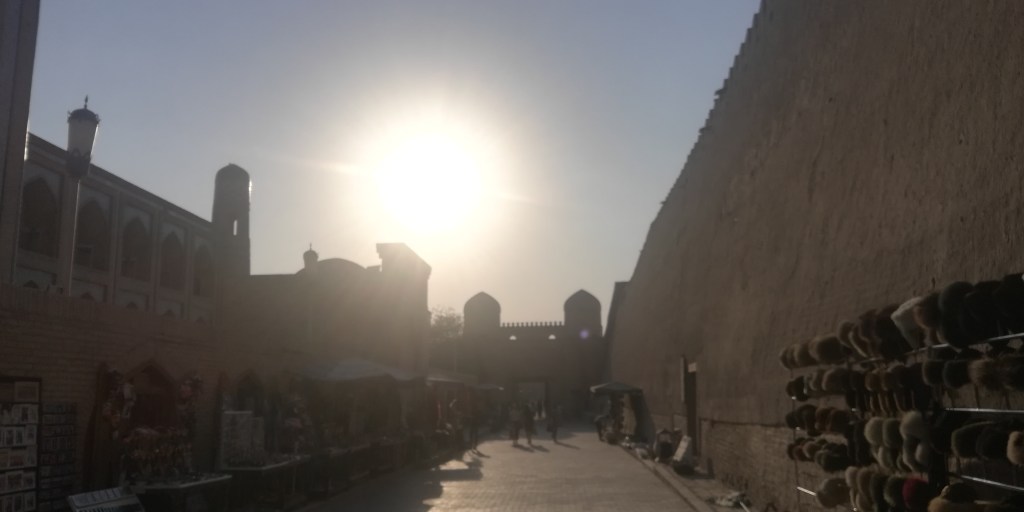
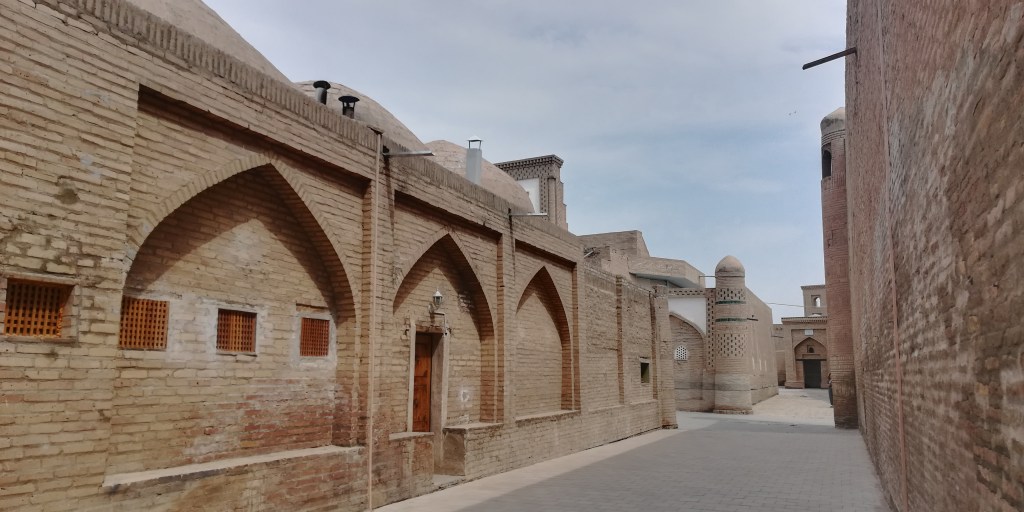
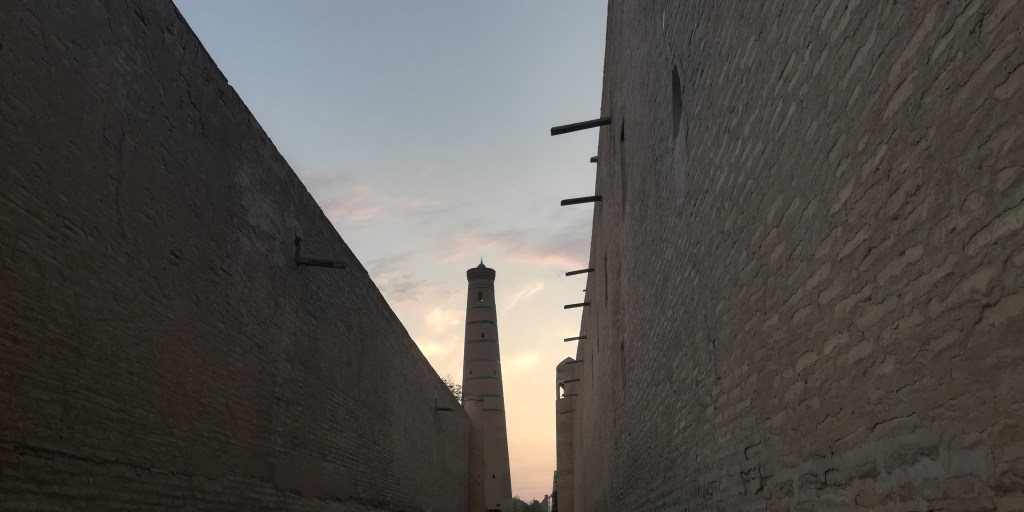
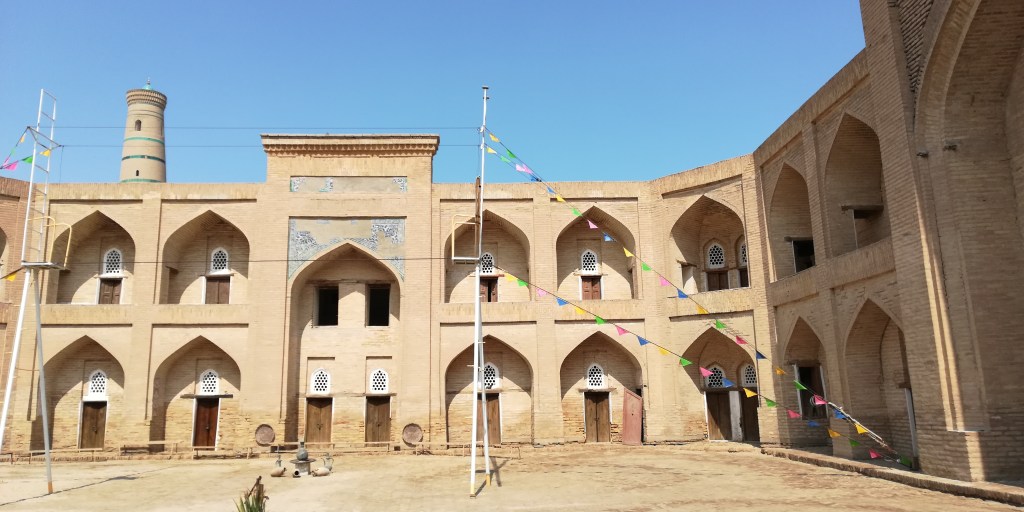
The main street of Ichan Kala is lined with souvenir stands selling clothes, bags and furry hats. You could hear traditional music coming from the cafes and restaurants nearby. Though mostly catering to tourists, Ichan Kala is also home to a lot of people. If you take the side alleys and walk on for a bit, you will soon find yourself in the residential quarters. Some of the residents have turned part of their homes into guesthouses, offering lodging, boarding and excursions. Olden mosques and madrassas stand along the narrow streets of the inner city and are major tourist draws. Most prominent of them are the Kalta Minor, which is located near the entrance gate, and the Kutli Murad Inak Medressa, which was the biggest madrassa of Khiva.
Over the next few days, I would explore the many museums of the inner city, most of which were, forgive me for saying this, quite ordinary. They do however, throw some light onto the town that Khiva once was. Articles of clothing of the Khans and their families, ceramics and cloths that were traded along this stretch of the Silk Road, the scriptures that pupils here studied, and paintings that tell the stories of eminent personalities of Khiva and what life was like in those days, are on display. Learning from these museums help put things in perspective and when you walk along the brick laden streets, lined with ancient buildings, you find yourself traversing time and being one with the medieval city of Khiva.
The most popular landmark in all of Ichan Kala is the Mausoleum of Pahlawan Mahmud. Born in 1247, he was a man of many talents; a Sufi poet, philosopher, saint, craftsman and a famous wrestler who had won many competitions all over Uzbekistan, Persia and India. Today, he rests in his elaborately decorated mausoleum, along with the royals of Khiva. His mausoleum is busy with pilgrims throughout the day. Recitations from the Quran and of his poems take place in the lavish main hall multiple times a day, in rapt attention of the visitors. The beautiful blue tiled dome of his mausoleum stands prominently in the skyline of the city.
Another landmark that gets a lot of visitors is the Juma Mosque. It is a 10th century mosque, consisting of more than 200 carved wooden pillars. Though rebuilt in the 18th Century, some of the pillars from the original old mosque still stand. It is said that witnessing the Friday prayers at the mosque is an experience that shouldn’t be missed.
The sky turns dark and the tourists start to go off to their tour buses and hotels. I decide to grab some dinner at an outdoor restaurant near the Kalta Minor. As shashlik kebabs grill over the charcoal oven, its aromatic meat smoke fills the air. Served with the local bread and a generous amount of black tea, the kebabs taste divine. Needless to say, I order a few more.
After dinner, guided by the lights of the city walls, I walk back to my hotel. The only way to make this night better is a long shower, followed by some CNN, which is the only English channel available on my TV. I fall asleep in my comfortable bed while watching a news report about the ongoing Hong Kong protests.
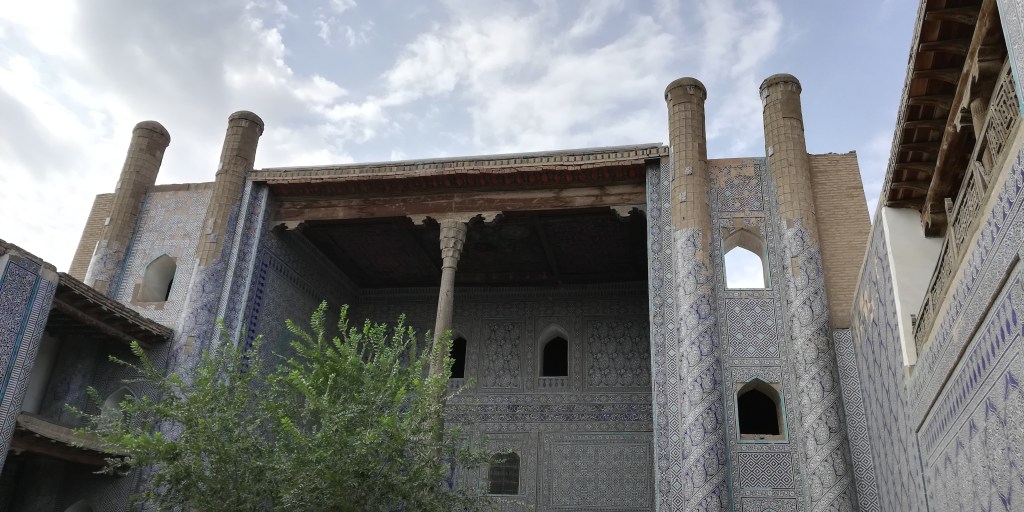
I devote a day to see the sights of the outer city, Dishan Kala, but apart from a rickety ferris wheel and a couple of empty Soviet era parks, I do not see much. There is a strange air of desolation all around. The only signs of life are the few workers tending to the grass and dry shrubs. In one of the parks, I see an abandoned set of rides for children; slides, bumper cars, monkey bars and such. It did not look like they have been used since the Russians left.
Out in the business district, vans and cars ply the road as barber and grocery shops open their doors for business. The warm breeze sweeps up the loose soil into the air, leaving a layer of dust over clothes and exposed skin. As I walk down the sidewalks, I see people queuing outside offices. Armed guards patrol the vicinity of the high-walled government buildings. As morning turn to afternoon, the road side restaurants open up slowly and the owners invite me in for lunch.
“Shashlik? Plov? Beer?” A young man asks as I walk by his restaurant. The place is empty; the plastic chairs and tables placed in the courtyard outside is covered in blown off dust.
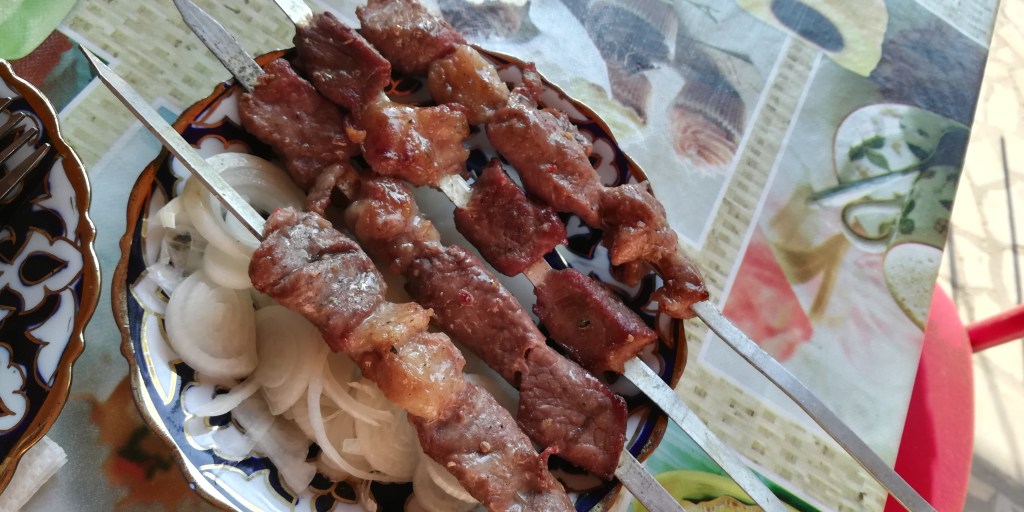
But a cold mug of beer was too good an offer to refuse and I decide to go in. With not much to see and do, I order a few shashliks, a plate of plov and a few beers. The shaded courtyard is the perfect hideout from the heat. As I devour the delicious dishes, I watch cars and people pass by. It is a slow, quiet afternoon and is a welcome change from the crowded alleys of Ichan Kala.
The waiter tells me that the trick to make a good shashlik skewer is to have a few pieces of grilled fat in there as well. It makes it more juicy and flavourful. I learn, a bit too late however, that you have to eat it while its hot or it will stick in the insides your mouth.
As awesome as the kebabs tasted, I could feel my teeth and gums being covered in leathery animal fat. As kids playfully jumped into the stream and the waters of a nearby fountain, I walk back to my hotel and brush my teeth.. several times over the next few hours. My breath reminded me of the smells we encounter in butcher houses, after a fresh round of slaughter. Disgusting.
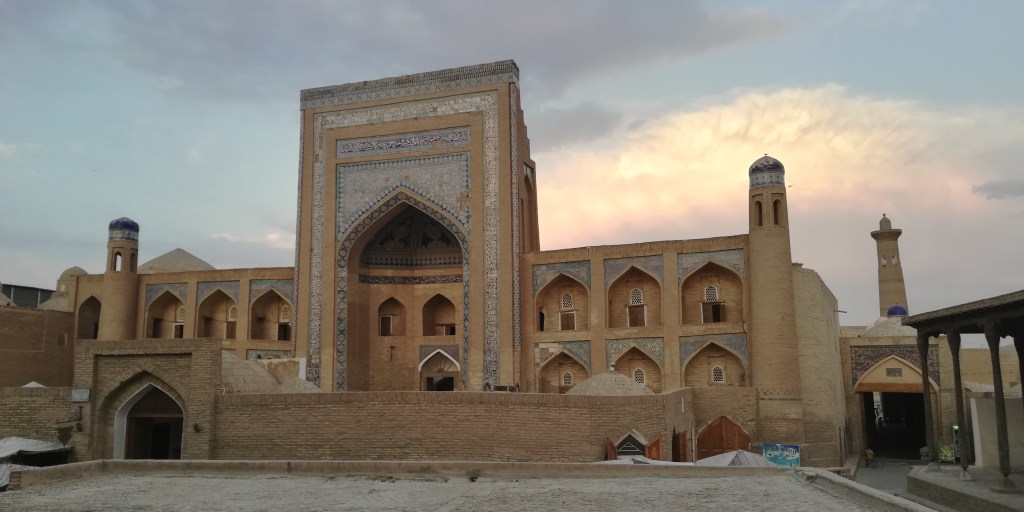
As the sun went down that evening, I take a stroll around the neighborhood of the hotel. I meet Ruslan, who was hanging out by the entrance gates of the inner city, with his friends. They ask me about India and take a bunch of pictures. Kids play around noisily around the gates; some riding their bike, some just running around crazily. Under the clear night sky and the twinkling stars, the lights on the walls of Ichan Kala pierce through the darkness. I walk along the walls to the nearby supermarket to buy some bread and cakes for dinner, and a fresh set of mints.
I fall asleep that night watching a news report on CNN about a village in India’s state of Meghalaya, where people communicate with each other by whistling. Nicknamed the Whistling Village, names of every resident are in the form of unique sounding whistles. Wow!
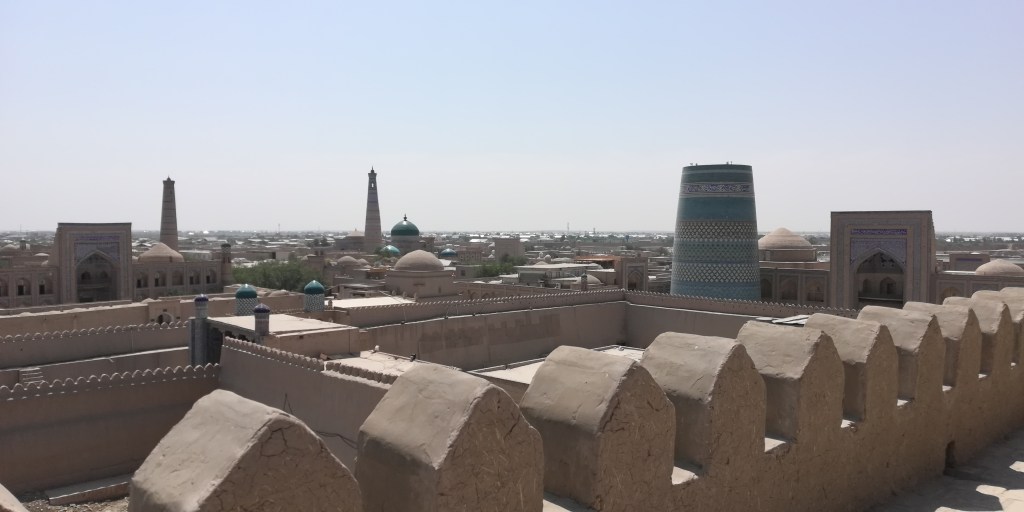
On my last day in Khiva, I decide to climb up to the watchtower. As they say, I had saved the best for last. The sun was mercilessly beating down and the warm breeze was not helping either. The staircase is narrow and not in very good condition. It winds its way up to the top of the city wall where the tower is located and as I climb the sounds of my boots echoes in the dimly lit staircase.
Up on top, the view is mesmerising. You see the entire Ichan Kala, with all its age-old buildings and alleys, laid out in front of you. Beyond the inner city walls, you see the modern present of Dishan Kala, with its cars, hotels and office buildings.
Sitting up there, looking down on the inner city, you cannot help but imagine how things must have been. I sit there day dreaming about caravans entering and exiting the city. Men and women, with their hands bound in chains and ropes, following their rich owners, who ride on ornate camels, on their way to a buyer’s house. Alleys busy with merchants negotiating trade deals of exotic goods from China, Africa and beyond. People rushing to the mosques to offer prayers. Wary travelers rejuvenating and exchanging stories while sipping tea and gorging on delicious meals at the eating houses; the shop owners swatting off flies attracted towards the hanging animal carcasses outside. All of this, under the watchful eyes of the guards stationed on the watch tower, where I sit now. I do not know how accurate my imagination is, but it painted an interesting picture, nonetheless.
The incredible journey of places like Khiva, make you wonder what the places we live in now will look like a few centuries later. Will they survive? What are the buildings that will stand the test of time? What will the future generations, based on the remains we leave behind, think of us?
I wake up early in the morning. I had asked Ruslan to meet me at 6 am to take me to the airport at Urgench, which is around a 40 minute drive. I am going back to Tashkent from where I have a flight back home a few days later. I feel a bit sad that my trip is on its last legs, but at the same time I am strangely glad to be leaving Khiva. I feel I will have a lot more to see and do in Tashkent. As I pack my bags and put on my shoes, I hear a knock on the door. Ruslan has arrived.
I dump my backpack in the backseat of his car and, walking to the passenger seat, I catch a glimpse of the inner city walls, around which I had spent my days. As compared to the day when I first saw them, they looked a lot less intimidating now.
The cool morning breeze feels good as we drive towards Urgench. As we drive past shops and farms on the outskirts of Khiva, I wonder if I’ll ever be back here again.
“Probably not.”
Truth be told, as comfortable and relaxing as my stay was, Khiva was not my favourite stop of this trip. I had thought it would be smaller and relatively untouched. Instead, it turned out to be very touristy. I don’t know why but swiping a ticket to enter Ichan Kala every time made me feel like I was entering an amusement park, where instead of rides, you have old monuments.
However, I do understand that the tourists, including me, were there for a reason. It is the history of the place. The mausoleum. The madrassas. The mosques. The museums. It makes for an exciting and enriching destination.
And, the booming tourism is actually a good thing for Khiva. It generates a lot of business and employment for the people here. Most of the hotels, restaurants and shops would not exist had it not been for the buses bringing in the large tour groups. Revenue generated from the entrance tickets play a major role in preserving these ancient buildings.
What I will miss about Khiva are the aimless strolls, passing time talking to the waiters of restaurants on lazy afternoons, watching shashliks being cooked over coal, having after-meal coffee at cafes while reading a book or listening to music, taking long showers, catching up on my naps and news reports on CNN. But most of all, I’ll miss sitting by the gates of Ichan Kala, under the evening lights, imagining the fascinating journey through time of this age old wonder.
Dolce Far Niente is an Italian phrase that translates to “the sweetness of doing nothing”. Nothing captures the essence of my stay in Khiva better than this phrase.
Dolce Far Niente.


Leave a comment