I wake up to the loud thumps of monkeys jumping about on the asbestos roof. Early morning rays of the sun creeps in from in between the curtains, lighting up parts of the bed. I drag up the layers of thick blankets over my face, trying desperately to catch some more sleep. As the thumping continues, it becomes quite clear that sleeping is no longer an option.
I fish out my phone from underneath the pillows. 7.30 AM.
“Fucking monkeys!”
Next order of business is to leave the collective warmth of the three blankets, layered on top of each other, and reach out to the telephone kept on the bedside table; a task that is easier said than done in the early morning cold after being rudely awakened by unruly primates.
“Ek black coffee bhijwa do please.” (Please send one black coffee) I say to the kitchen staff of the forest lodge.
The next task is even more difficult. Getting out of bed.
By the time the coffee arrives, I have put on my thermals and turned on the geyser for a warm shower. Kush, the caretaker of the lodge, comes in with a flask, wearing his signature shawl, woolen cap and warm smile, and sets it on the table in the balcony.
“Sirji, breakfast loge?” (Will you have breakfast?) He asks knowing fully well that I will not. I have not ordered breakfast here since I checked in five days back.
Outside on the balcony of my first floor room, I spend the next hour or so, sipping the horrendous but warm instant coffee, while watching the monkeys play around the branches of the deodar trees surrounding the lodge. Down below, the two pet dogs of the lodge stroll around, looking for something to eat or someone to play with. The morning sun provides some much needed warmth after a night of cold.
“Did you sleep well?” A familiar voice comes from down below, somewhere around the foot of the nearby trees. It is Sameer, the manager of the lodge; a well spoken, middle aged man with spiked hair, always sporting a cool jacket. He is standing under a tree, smoking, well… something. “You get up early!”
“The bloody heater stopped working in the middle of the night and then I was rudely awakened by the monkeys!” I wanted to yell back.
“Yes, sometimes. How are you doing?” I chose to be civil.
“I came early to plan tonight’s event. Its Lohri. Be here by six!”
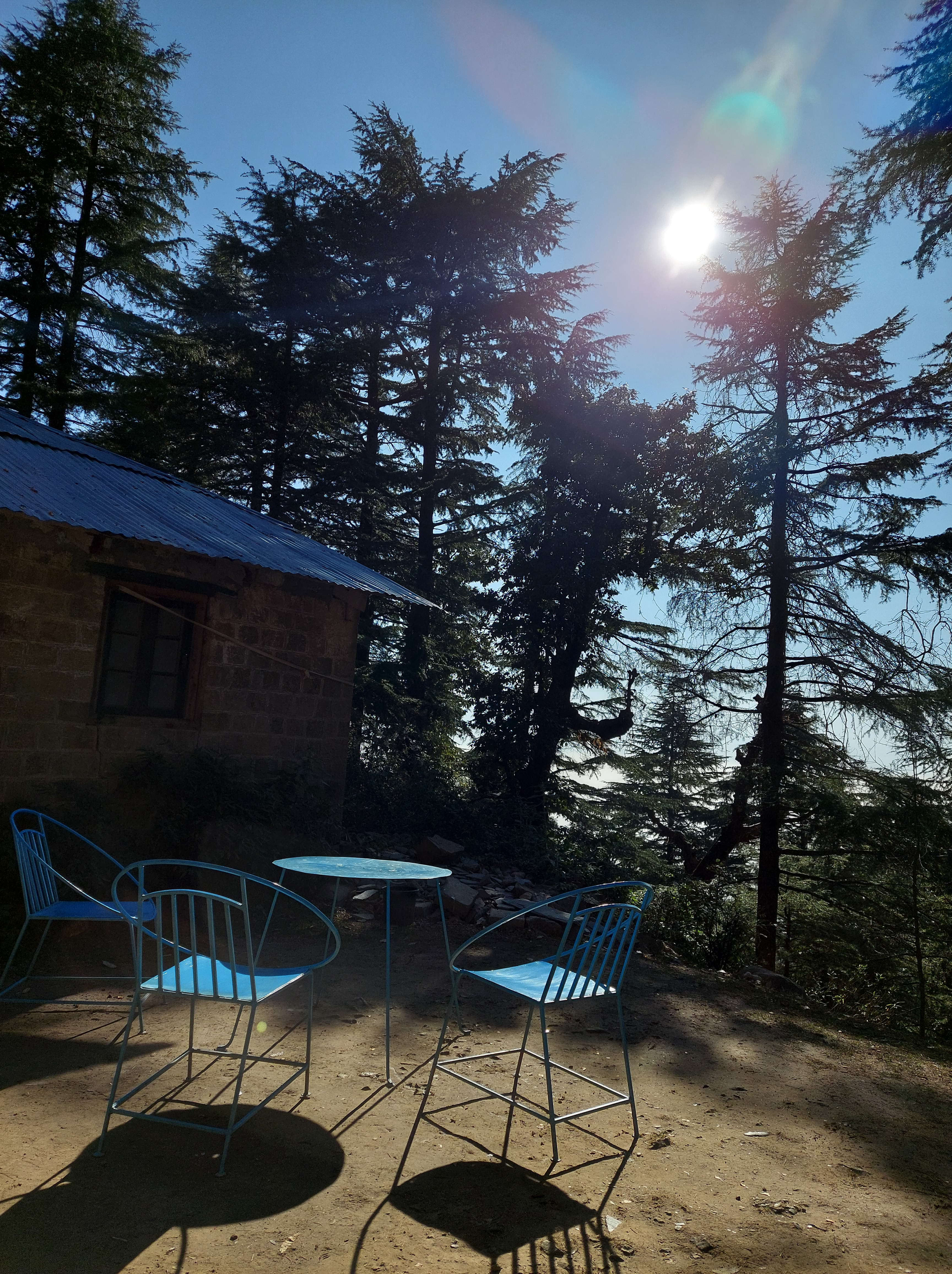
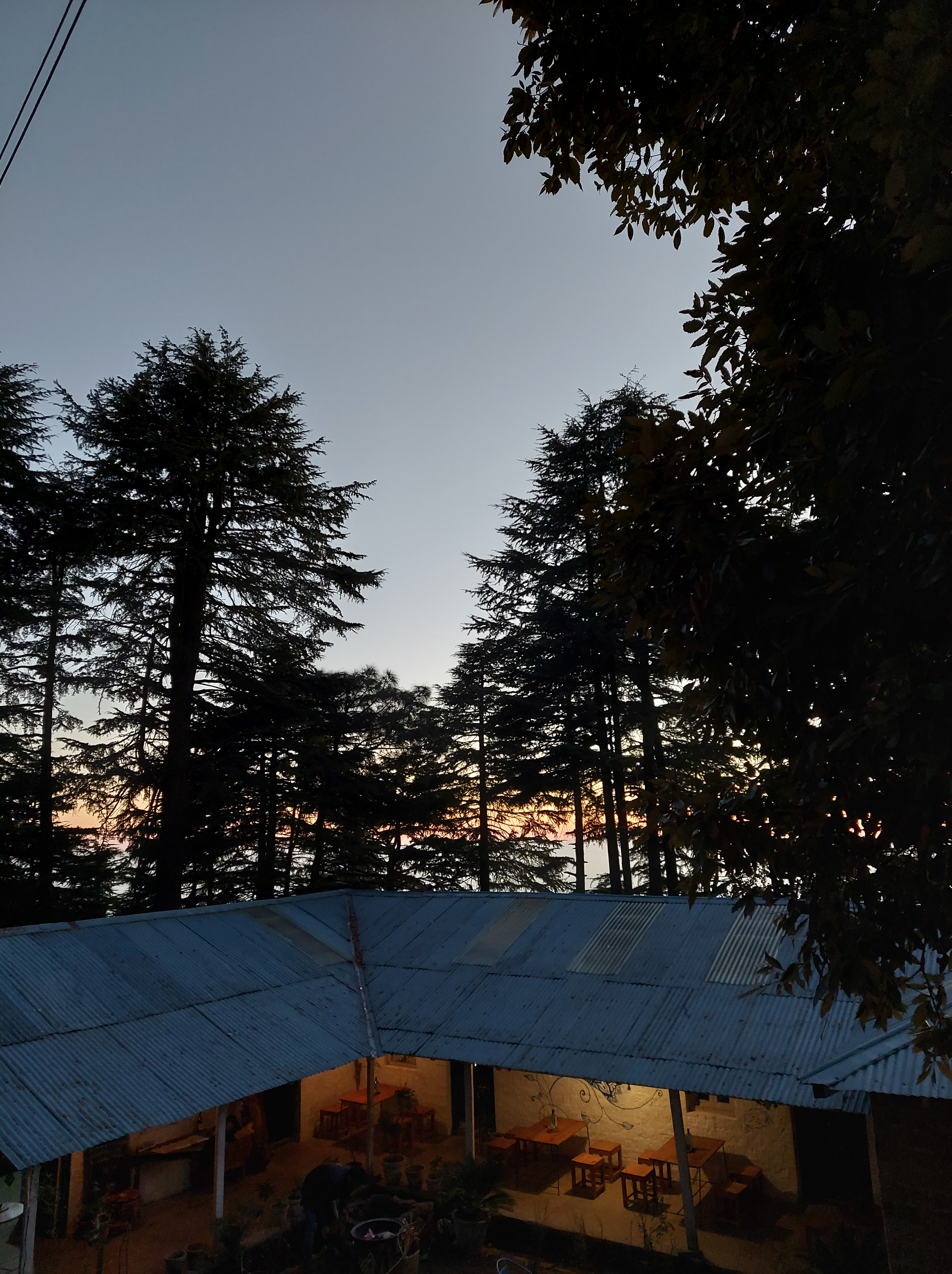
The lodge I am staying at is an uncomfortable forty minute uphill walk from the main square of McLeodganj. Surrounded by tall deodhar trees, it is a great place for lazy mornings, mesmerizing sunsets, lively music and nightly bonfires. You can spend the day watching the monkeys jump around the trees, playing with the pet dogs or just reading a book while listening to the birds. Around mid-day, the monkeys descend from the trees and feast on the food the lodge staff put out for them. Even though they will not admit it, but it is a bribe that they pay the monkeys to leave their paying customers alone.
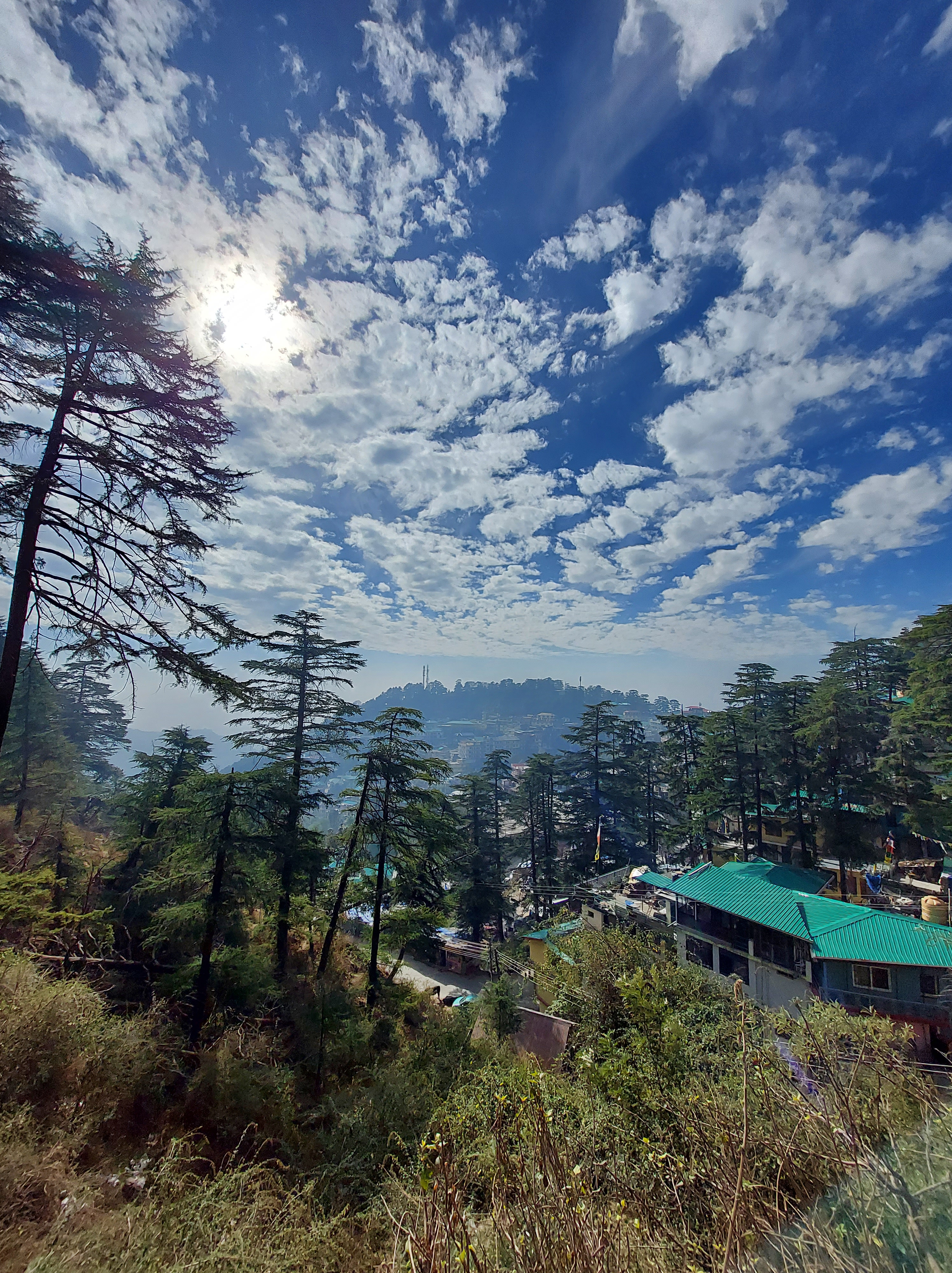
By 10 am, I freshen up and walk to my breakfast spot; a small tea stall owned by a middle aged man from Punjab. As my usual spread of bread, omelette and ginger tea gets prepared, I take a seat on a plastic chair, overlooking the valley. White cotton clouds float through the blue skies; the snow capped peaks of the mountains in the distance glisten in sunlight. From where I sit, I can see several small villages amidst the sea of green, sprinkled all over the nearby mountains; narrow roads snake through some of them with cars driving up and down like a colony of busy ants. As the cool mountain breeze blows, the colourful Buddhist prayer flags flutter overhead. If I had a spot like this back home, I would have breakfast more often. The weather is particularly pleasant today so I order another cup of chai. It is not like I have to be anywhere. I am on vacation.
Every year for the past decade or so, I am have been spending my vacations backpacking abroad. Then early last year, just after I returned from Japan, the lockdown era began and the world came to a sudden stop. As the scientists all over the world worked overtime to find a cure, most of us confined ourselves to the safety of our homes. Like many others, I too realised how dependent I was on house-helps, food delivery and laundry services. As I learnt to cook, clean and wash, the travel bug inside me grew restless. Let alone travel, I was unsure about even planning a trip in the post-pandemic world. I tried to distract the bug with books, movies, video games; hell, I even bought a guitar!; but nothing seemed to work.
As time passed, the true devastation of this menace became clearer. Perched comfortably on a couch in my air-conditioned house, I watched TV reports of how thousands of my countrymen were walking back to their villages on the other side of this country. Some walked barefoot. Some with infants. Many did not make it. There were news of the medical infrastructure being overwhelmed and the sick not even getting a hospital bed.
Soon, I would hear news of some of my friends and acquaintances contracting this disease. Today, millions of lives have been lost due to this disease and many more are still fighting to stay alive.
In comparison, my travel bug “problem” was not even a problem.
“Sit at home and don’t fall sick, you privileged jerk! You will travel again if you successfully make it to the other side.” I would tell the travel bug regularly.
As 2020 progressed, the number of cases eventually started dropping and the world slowly opened up again. We saw newer rules being implemented for the prospective traveler. Medical reports, quarantine requirements added to the complexities of international travel, making domestic travel the only viable option for me.
“Clearly, the travel bug ultimately won. The pandemic is still not over and here I am, looking at this beautiful view.” I realise as my second cup of chai arrives.
As things slowly normalise though, I realise that the threat is far from over. The mask around my face and the bottle of sanitiser in my pocket are not going anywhere anytime soon. During this trip, while I am mesmerised by the views of the Dhauladhar range, a part of me is always checking if my mask is properly on or wondering if I touched something and needed to sanitise my hands again.
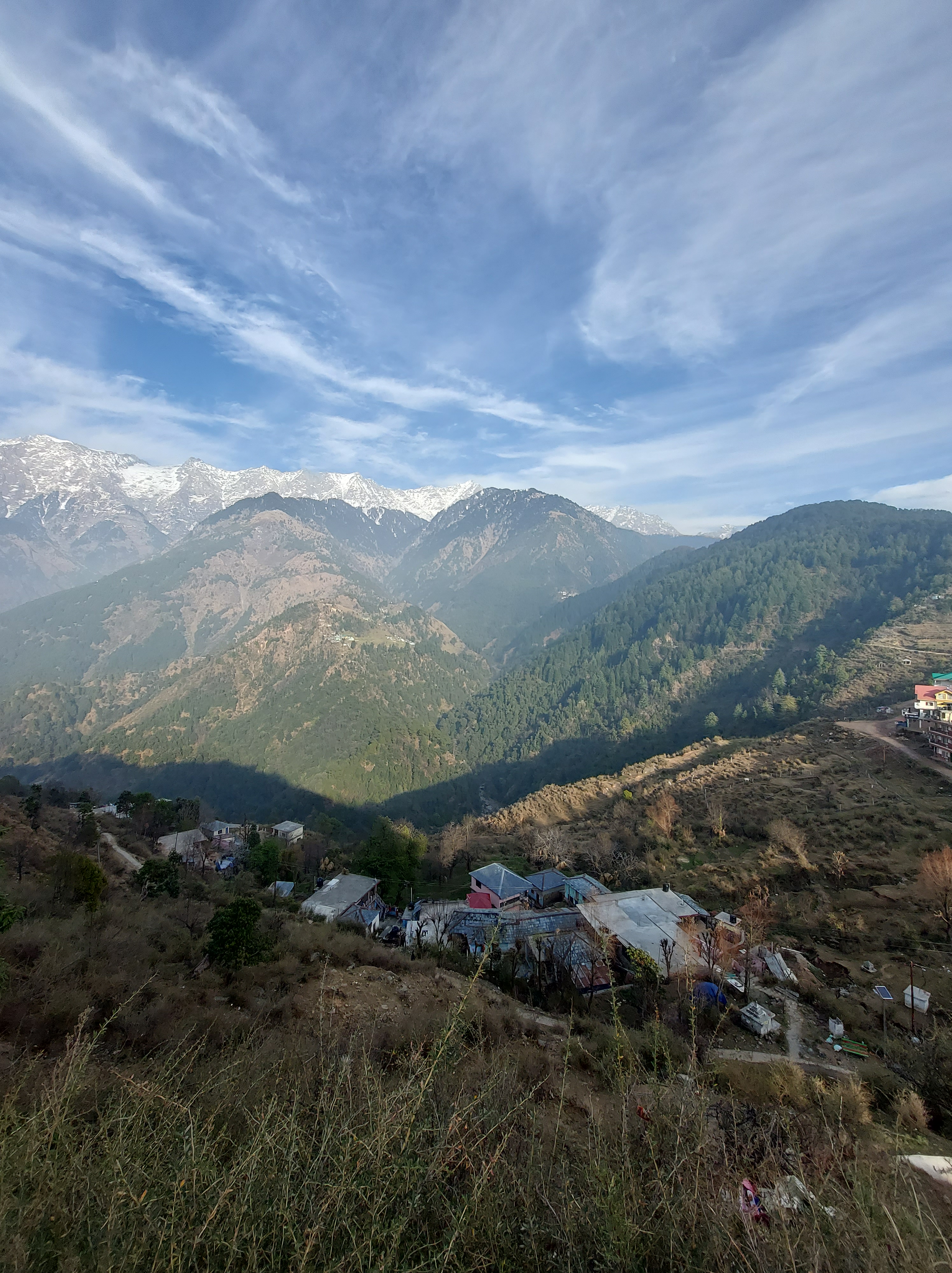
After a long and lazy breakfast, I decide to walk to the town of McLeodganj to spend the day. It takes about an hour from the tea stall, but since the road is mostly downhill, it is a pleasant walk and builds up the appetite for some lunch later in the day. I have been following this morning routine, give or take a little, for the last few days and I quite look forward to this walk.
While mostly surrounded by trees, there are a few spots along this route that offer nice views of the mountains. Walking along the side of the road to avoid the occasional car speeding past, I see shepherds with herds of sheep and donkeys passing through. Every now and then, I find myself being followed by a dog. Give him a treat and he will follow you all the way to Mcleodganj; if he does not get distracted by monkeys along the way, that is. (I am normally petrified of dogs, but Himachali dogs are the friendliest dogs ever.) As I get close to the town, at places, I see abandoned looking cafes and guesthouses; traces of the past tourism boom;. At certain other places, I see renovations and constructions going on; signs of hope for the future.
Mcleodganj is named after a Calcutta born Brit named Sir Donald Friell McLeod, who served as the Governor of Punjab and was revered for his role in introducing vernacular languages in the university curriculum, establishing the Oriental College in Lahore and developing roads, railways and canals in the province during his service life in the East India Company. The town back in the day used to be a retreat for the British and traces of that are still visible to keen eyes; graveyards, a church and some buildings from that era still remain in and around the town. It has been long since the British left and the town is now the base for the Tibetian Government in exile since 1959-60 and is lovingly called Little Lhasa. It is also the home of the 14th Dalai Lama and is considered to be a place of pilgrimage and spirituality for many.
The main traffic junction of the town is right in the heart of the market. Cars with number plates from Punjab, Delhi, Uttarakhand, Haryana, Chandigarh and Himachal honk their way through the crowded intersection on their way to major tourist hotspots like Bhagsunag Fall, Dal Lake etc. Sitting at one of the cafes, overlooking the intersection, I take in all the action around; tourists with selfie sticks, kids going to school, orange robed monks bargaining with vegetables vendors. From across the road from where I sit, are famous establishments like the Tibetian kitchen, which is said to serve the best momos in town; Mcllo Restaurant, which Agent 007, Pierce Brosnan, visited during his stay here; a smiling picture of him hangs on one of the restaurant walls. And then there is the hole in the wall restaurant, Kalimpong, which is my favourite eating joint in town. The ambience, the staff, the food and the coziness of the place hits the spot every time. You know a place is good when you see that it is popular among the residents.
The demographics of the town is an interesting mix of locals, Tibetians and tourists from around the world. Nowhere else is it more clearly evident than in some of the bigger restaurants in the area where you can find dishes like chole bhature, biryani, pasta, dosas, momos and Tibetian dishes like Tingmo and Thentuks, all in one menu!
Underneath the exuberance of crowded markets full of tourists, shopping their hearts out at souvenir shops, and chattering about in the numerous restaurants and cafes, you can feel the undercurrents of a brewing revolution. Signs and slogans demanding a free Tibet are not hard to find here. There are shops here that proudly declare that a part of their sale proceeds go to the student community that is actively raising awareness towards their right for a free Tibet.
I spend the next few hours, lazing about, sipping coffees and reading my book. By 3 PM, I feel ready for lunch. Normally I would go for a plate of mutton momos at Kalimpong, but today I feel I need some change. I walk through the crowd to the other end of the market to Labooze. Pre-Corona, I am told this was a pretty happening place in town. Nice views of the valley, a DJ set up, a dance floor, good food and great drinks. Now, things are a bit on the down low, but the view remains great and so does the food and the drinks. The friendly staff jokingly tell me that Labooze is the most popular landmark in McLeodganj, after the Dalai Lama’s Namgyal monastery.
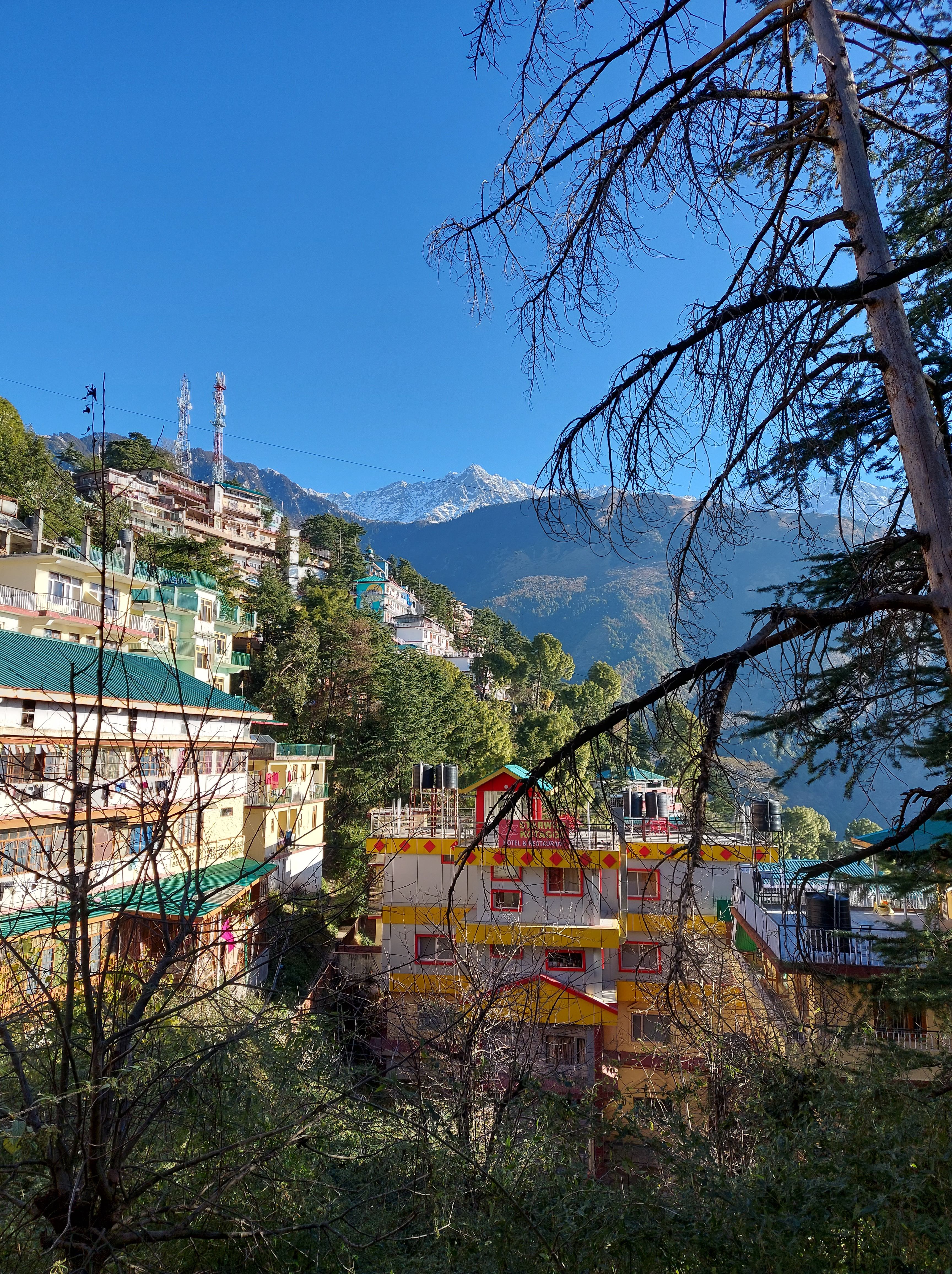
The monastery is a short walk away from Labooze but, like many other places of worship, is closed right now because of the pandemic. I did not know that in advance and showed up at the gates a few days ago. While the guard turned me away pointing at an official looking announcement pasted on the window of his cabin, the vegetable seller sitting across the street gestured for me to take the narrow side road along the outer walls of the monastery complex.
“Kora” he kept saying.
Being the ignorant fuck that I am, I thought he was pointing me towards a back gate of the monastery that may still be open. I thanked him and took the road. As it turns out, the road takes you around the monastery and the Dalai Lama’s residence. It is considered to be a holy route, and locally known as the Kora circuit.
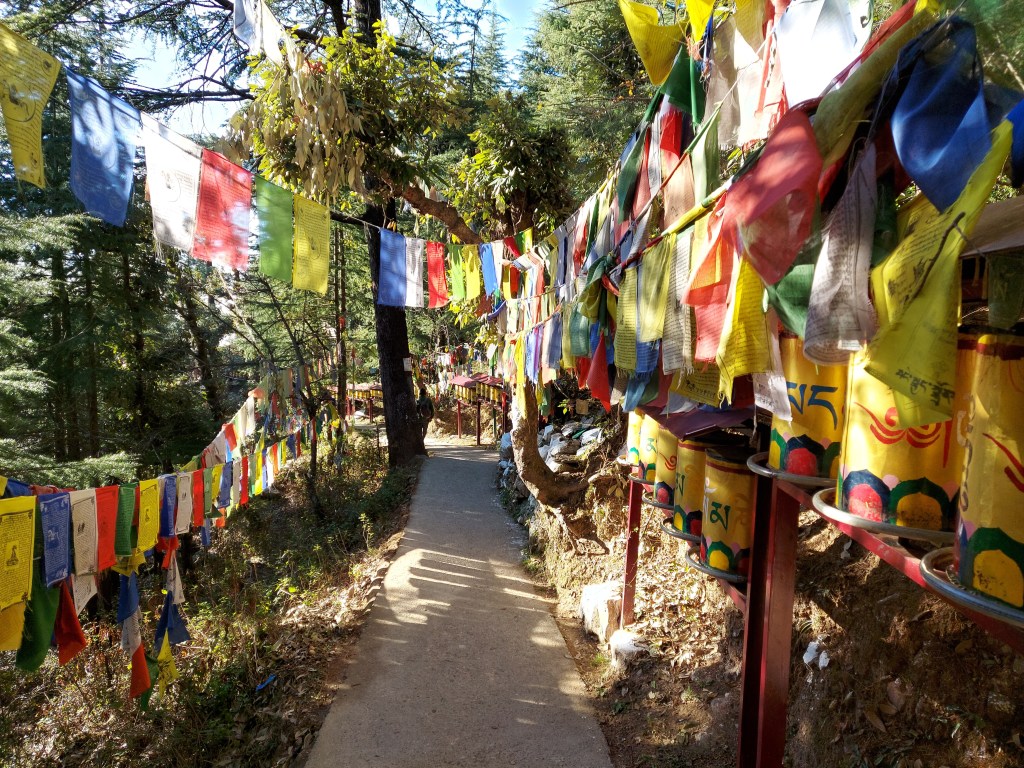
Though the walk along the Kora circuit took only about an hour, it was quite easily one of the best experiences I have had in McLeodganj. The hilly road was full of greenery on either side, occasionally opening up to breathtaking views of the valley and snowcapped mountains. The lines of Buddhist prayer flags danced to the rhythms of the cool mountain breeze. Every now and then, I would see monks, who would never fail to return back a smile. The prayer wheels along the way creaked as I gave them a little spin. Apart from the chirps of birds and rustling of leaves, there was hardly any other sound.
Sometimes you chance upon places that make your day and this was one such place. And it is all thanks to the vegetable seller who I thought was crazy.
Back in Labooze, a few beers and a lot of junk food later, I start getting ready to leave. It is 5.15 PM and will be getting dark soon. The evenings are beautiful at the forest lodge. And ofcourse, there is the Lohri event that Sameer told me about. Tonight will also be my last night here for tomorrow I check out and leave for a nearby hill town, Dharamkot. A few days there and then, Manali.
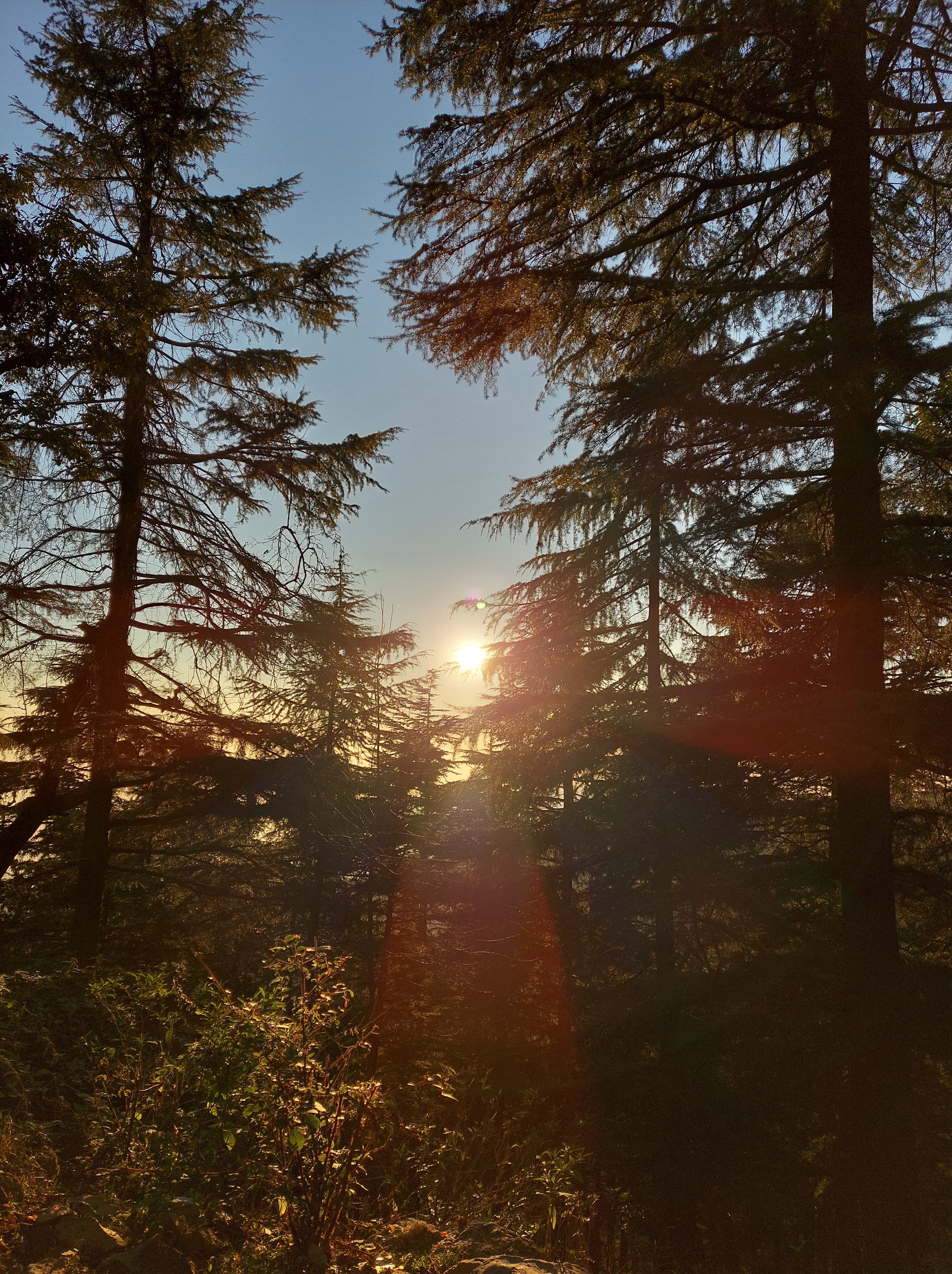
The taxi dropped me off at the lodge just before sunset and from between the tall trees, I see the sun slowly set. Mesmerised by the setting sun, the golden skies and the birds flying back to their nests for the night, its hard to imagine that for the staff this was a mundane occurrence. How can Kush be standing in the corner and chatting on his phone when the best sunset view in Himachal is right there in his backyard!
He smiles when he sees me, as if nothing special is happening.
“Thand hai aaj. Lekin rewri aur popcorn ka maza toh thand me hi hai” (It’s cold today. But sweets and popcorns are best enjoyed in such cold weather.)
I smile and nod, and then go back to looking at the view.
The shadows of the trees engulf the surroundings and soon the darkness of the night takes over. Last minute preparations are going on, as I see Kush decorating the porch with paper kites and ready the firewood for the bon-fire. Soon, the lodge starts to buzz with other guests and friends of the staff. The bonfire is lit and someone picks up the guitar and starts playing some classics. A big plate of popcorn and sweets arrive from the kitchen.
We spend the next few hours, sitting around the bonfire, talking, laughing, clapping and singing along. That night, under the orange hue of the fire, amidst the warm people and soothing tunes, the horrors of the outbreak seemed like a long lost memory. The travel bug was finally at peace.
Up above, the clear night sky was dotted with bright, twinkling stars.
“You can’t find them in Mumbai, can you?” Someone asked, seeing me look up at the sky, trying to identify constellations.
“Frankly in Mumbai, I haven’t even tried.”
(Note: The draft of this post was written in January 2021. Presently, India is dealing with a viscous second wave. Its all over the news if you want to find out about the true magnitude of the ongoing devastation. People are suffering and dying. The virus is getting closer home each day. Request everyone to take care, be strong and stay safe. We will make it to the other side.
On a lighter vein though, the travel bug is getting restless again. Time to tune up the guitar!)


Leave a Reply